Summary
- Long sitting can worsen discomfort: Continuous pressure and friction may aggravate existing pilonidal sinus symptoms.
- Regular movement helps: Taking breaks, changing positions and avoiding hard surfaces can reduce pressure around the tailbone.
- Persistent symptoms need care: A healthcare professional should evaluate recurrent pain, swelling, or discharge.
Article Medically Reviewed by Dr Amita Jain, MBBS, MS (Gen Surgery), Fellowship (AIIMS), Military-Precision Gallbladder Treatment Specialist, Surgeon, Senior General Surgeon: 29 Years of Surgical Excellence by Ex-Indian Army Surgeon
For people who spend several hours sitting at a desk, driving, studying, or working from home, discomfort around the tailbone can be easy to dismiss. However, for someone with pilonidal sinus, prolonged sitting may make symptoms more uncomfortable and can contribute to irritation around the affected area.
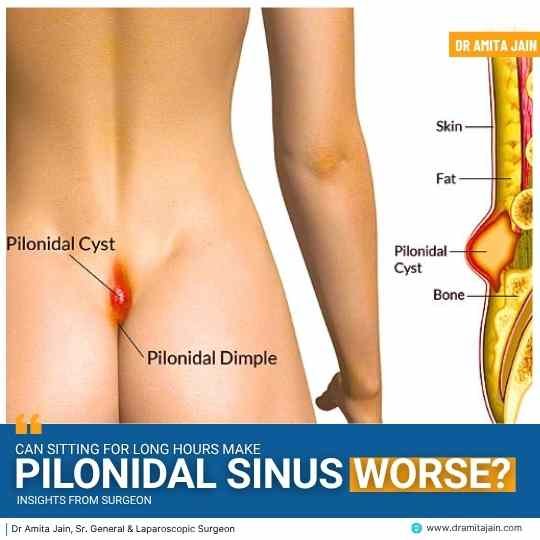
Pilonidal sinus is a condition in which a small tunnel or cavity develops in the skin near the tailbone, often containing hair and debris. It can remain relatively quiet for some time or become inflamed and infected, leading to pain, swelling and discharge. While sitting for long periods does not necessarily cause pilonidal sinus on its own, it can aggravate an existing condition, shares Dr Amita Jain, Senior General and Laparoscopic Surgeon, Specialist for Pilonidal Sinus treatment in Delhi and India.
How Does Prolonged Sitting Affect Pilonidal Sinus?
Sitting for extended periods puts continuous pressure on the area around the tailbone. This pressure can increase friction and irritation, particularly when a person sits on a hard surface or maintains the same position for several hours.
The affected area may become more uncomfortable, especially when inflammation is already present. Prolonged sitting can also create warmth and moisture in the skin folds, which may further contribute to irritation.
For people who already experience symptoms, regularly getting up and changing position can help reduce continuous pressure on the affected area.
“While prolonged sitting may aggravate pilonidal sinus symptoms, timely care and simple changes can help reduce discomfort.” – Dr Amita Jain, Senior General Surgeon, MBBS, MS (General Surgery), Fellowship (AIIMS) in Laparoscopy | Proctologist | Ex-Professor Surgery | 30+ Years of Surgical Experience
The Role of Pressure and Friction
Pressure and friction are important factors when it comes to pilonidal sinus symptoms. When the skin repeatedly rubs against clothing or another surface, irritation can increase.
Long periods of sitting can place additional mechanical stress on the skin around the tailbone. Tight clothing, poor sitting posture and hard chairs may make this discomfort more noticeable.
Reducing unnecessary pressure and friction can therefore be an important part of managing symptoms, although it does not eliminate the underlying sinus.
Prolonged Sitting Is Not the Only Factor
It is important to understand that pilonidal sinus has several contributing factors. Hair growth, friction, skin characteristics, sweating, prolonged sitting and pressure around the tailbone can all play a role.
Therefore, simply avoiding sitting for long periods may not prevent the condition or permanently resolve it. Someone who has recurrent swelling, pain or discharge may need medical assessment to determine the appropriate treatment.
Signs That the Condition May Be Getting Worse
An increase in pain or tenderness around the tailbone can indicate that the sinus is becoming inflamed. Swelling, redness, warmth or a painful lump may also develop.
If an infection occurs, pus or blood-stained discharge may appear. Some people may also experience fever or feel generally unwell. These symptoms should not be ignored, particularly when they are becoming more severe or recurring frequently.
Simple Ways to Reduce Discomfort While Sitting
People who need to sit for long periods can make a few practical changes to reduce pressure on the affected area. Taking regular breaks to stand and walk can prevent continuous pressure on the tailbone.
Using a comfortable sitting surface and avoiding prolonged sitting on hard chairs may also help. Keeping the area clean and dry is important, while loose, breathable clothing can help reduce friction and moisture. These measures may improve comfort, but they should not be considered a substitute for medical treatment when an infection or persistent sinus is present.
Treatment Depends on the Severity of the Condition
Mild symptoms may sometimes be managed with appropriate hygiene and lifestyle measures, but an infected or recurrent pilonidal sinus may require medical treatment.
If an abscess develops, a doctor may recommend drainage to remove the accumulated pus. For recurrent or persistent disease, a surgeon may discuss procedures designed to remove or treat the sinus and reduce the likelihood of recurrence. The appropriate treatment depends on the individual’s symptoms, the extent of the sinus and whether infection is present.
When Medical Attention Is Needed
Persistent pain, swelling, discharge, a recurring lump near the tailbone or signs of infection should be evaluated by a healthcare professional. Immediate medical attention may be particularly important if severe pain is accompanied by fever or rapidly increasing swelling. Getting the condition assessed early can help prevent worsening infection and determine whether conservative care or a procedure is appropriate.
Breaking Up Long Sitting Can Help
Long hours of uninterrupted sitting can increase pressure, friction and discomfort around the tailbone in people with pilonidal sinus. While sitting is not necessarily the sole cause of the condition, reducing prolonged pressure can help manage irritation and improve comfort.
Regular movement, appropriate hygiene and avoiding unnecessary friction can be useful supportive measures. However, recurrent or infected pilonidal sinus should be medically evaluated rather than managed through sitting changes alone.

Dr Amita Jain, one of the most experienced General and Laparoscopic Surgeons in Delhi, is widely recognised for her expertise in hernia, piles, gallbladder, fissure, and fistula surgeries. With an outstanding career spanning over 29 years, Dr Amita Jain has earned her place among the top General and Laparoscopic surgeons in Delhi and India, known for her precision, compassion, and consistent surgical excellence. She was the Professor of Surgery at the Army College of Medical Sciences and Base Hospital, Delhi Cantt. In 1994, she was commissioned as a surgeon under the United Nations Mission in Congo.
Dr Amita Jain currently serves as the Senior General and Laparoscopic Surgeon at Fortis C-DOC Hospital, B-16, Chirag Enclave, Opposite Devika Tower, Greater Kailash 1, New Delhi, Delhi 110048. She is also the Senior General and Laparoscopic Surgeon at Rosewalk – Luxury Multi-Speciality Hospital in Delhi and Rainbow Multi-Speciality Hospitals (at Malviya Nagar and Panchsheel Park, New Delhi)
Dr Amita Jain has successfully performed a wide range of complex general surgeries, including both open and minimally invasive procedures, with a strong focus on trauma care, onco-surgical techniques, and reconstructive surgeries. Her medical specialisation includes – Gallbladder surgeries, appendix removal surgeries, hernia repair surgeries, Pilonidal Sinus treatments, varicose vein and piles surgeries, fistula surgeries and fissure surgeries. Learn More about Dr Amita Jain.
Dr Amita Jain has also authored some of the key medical journals and publications, like ResearchGate, IJSR
Note: the articles are written with Dr Amita Jain’s professional insights and referring to her medical publications.