Painless Piles Treatments and Haemorrhoids Surgeries
Comprehensive, Grade-Based Proctological Care by Senior Colorectal Surgeon Dr Amita Jain
Quick Summary for Patients:
Expert Care, US FDA-Approved Laser Procedures, and Lasting Relief from Hemorrhoids by a Leading Senior Proctologist & Senior General Surgeon
What Are Piles (Hemorrhoids)?
Piles, clinically termed hemorrhoids, are inflamed, swollen, and congested vascular cushions located within the lower rectum and anal canal. Hemorrhoids act as normal physiological structures that assist with anal continence. However, when repetitive intra-abdominal pressure, chronic constipation, or pelvic congestion occurs, these vascular cushions stretch, bleed, dilate, and prolapse.
Hemorrhoidal disease is anatomically divided into two primary types:
- Internal Hemorrhoids: Form above the dentate (pectinate) line inside the rectum. Because this area lacks somatic pain receptors, internal piles typically present with painless bright-red rectal bleeding and progressive tissue prolapse.
- External Hemorrhoids: Form below the dentate line under the sensitive perianal skin. These can develop into painful lumps, swellings, skin tags, or severe acute pain if a blood clot forms (thrombosed external hemorrhoid).
Grades of Internal Piles & Grade-Specific Treatment Approaches
Accurate staging determines whether conservative treatment, minimally invasive laser therapy, or advanced proctological surgery is indicated:
| Piles Grade |
Clinical Presentation & Tissue Prolapse |
Recommended Clinical & Surgical Treatment |
| Grade 1 Piles |
Internal vascular swelling; no prolapse outside the anus. Presents with painless bright-red bleeding on stool or tissue. |
Dietary modifications, high-fiber therapy, stool softeners, infrared coagulation, or injection sclerotherapy. |
| Grade 2 Piles |
Hemorrhoidal tissue prolapses during defecation or straining but retracts spontaneously back inside. |
Medical management, Rubber Band Ligation (RBL), or Laser Hemorrhoidoplasty (LHP) for recurring bleeding. |
| Grade 3 Piles |
Hemorrhoids prolapse during bowel movements and require manual reduction (pushing back inside with fingers). |
Minimally Invasive Laser Piles Treatment (LHP) or MIPH (Stapler Surgery); rapid daycare recovery. |
| Grade 4 Piles |
Permanently prolapsed tissue that cannot be manually reduced; high risk of strangulation, thrombosis, and ulceration. |
Advanced Laser-Assisted Hemorrhoidectomy or Ultrasonic/Harmonic Scalpel Hemorrhoidectomy. |
| Thrombosed Piles |
Sudden formation of a blood clot within an external hemorrhoid, presenting as an exquisitely tender, bluish-purple lump. |
Emergency proctological evaluation; urgent in-clinic clot excision or definitive surgical enucleation under local anesthesia. |
| Pregnancy Piles |
Hemorrhoids aggravated by hormonal changes, uterine pelvic pressure, and severe pregnancy-induced constipation. |
Trimester-safe conservative care, pelvic floor relaxation measures, and local soothing therapies; surgery reserved only for emergencies. |
Common Causes & Risk Factors of Piles
Hemorrhoids develop when chronic pelvic pressure weakens the supportive connective tissue (Parks’ ligament) holding the anal vascular cushions in place:
- Chronic Constipation & Straining: Passing hard, dry stools causes severe mechanical friction and venous engorgement.
- Prolonged Sitting on the Toilet Bowl: Extended smartphone use or reading on the toilet promotes prolonged venous pooling in the anorectal plexus.
- Low-Fiber & Dehydrated Diets: Diets deficient in dietary roughage lead to small, hard stools and sluggish colonic transit.
- Pregnancy & Natural Childbirth: Increased venous pressure from the growing uterus coupled with progesterone-induced venous dilation.
- Heavy Weightlifting & Strenuous Physical Work: Repetitive Valsalva maneuvers increase intra-abdominal and perianal pressure.
- Chronic Diarrhea: Frequent, acidic watery stools cause continuous mucosal irritation and pelvic floor muscle spasms.
Warning Signs & Symptoms of Piles
Do not ignore persistent anal discomfort. Watch for these common signs:
- Bright-Red Rectal Bleeding: Fresh, painless, bright-red blood splashing in the toilet bowl or streaking toilet tissue.
- Prolapsing Tissue: Prolapsing tissue or soft fleshy lumps emerging from the anus during bowel movements.
- Perianal Itching & Discharge: Perianal itching (pruritus ani), mucus discharge, and difficulty keeping the anal area dry and hygienic.
- Rectal Fullness & Ache: Dull ache or throbbing rectal fullness, often accompanied by the sensation of incomplete bowel evacuation (tenesmus).
- Acute Agonizing Pain: Acute, agonizing, sharp pain indicating a thrombosed external hemorrhoid or an associated anal fissure.
Points of Concern: When to Seek Immediate Proctological Care
Rectal bleeding is not always caused by piles. Consult a colorectal surgeon immediately if you experience:
- Signs of Acute Blood Loss: Dizziness, fainting, extreme paleness, or shortness of breath (signs of acute blood loss/anemia).
- Dark or Tarry Stools: Dark, maroon, or tarry black stools (melena).
- Systemic Symptoms: Unexplained weight loss, persistent fever, or abrupt alterations in bowel habits lasting over 2 weeks.
- Signs of Infection: High fever accompanied by swelling, foul-smelling pus discharge, or inability to pass urine (perianal abscess risk).
Accurate Diagnosis & Proctological Evaluation in Delhi
Self-medicating with over-the-counter ointments without an accurate clinical examination can delay diagnosis of serious colorectal conditions, such as colorectal polyps, Crohn’s disease, anal fissures, or rectal cancer.
During your private consultation at our South Delhi clinics, Dr Amita Jain performs a comprehensive 4-step evaluation:
- Detailed Clinical & Dietary History: Evaluation of bowel habits, bleeding patterns, chronicity, and previous medical or surgical interventions.
- External Visual Perianal Inspection: Detailed assessment for skin tags, thrombosed external hemorrhoids, anal fissures, perianal fistulas, or abscesses.
- Digital Rectal Examination (DRE): A gentle, lubricated examination assessing anal sphincter tone, rectal masses, and mucosal integrity.
- High-Definition Video Anoscopy: Direct visualization of the internal anal canal using an anoscope to precisely locate internal piles cushions (typically at 3, 7, and 11 o’clock anatomical positions) and determine their precise clinical grade.
- Flexible Sigmoidoscopy or Colonoscopy (When Indicated): Recommended for patients above 45–50 years of age or those with atypical bleeding to rule out proximal colonic pathology.
Modern Piles Treatments: Conservative, Laser & Minimally Invasive Surgery
1. Conservative Medical & Dietary Therapy (Grades 1 & Early Grade 2)
- High-Fiber Nutrition: Intake of 25–35g of dietary fiber daily (psyllium husk, flaxseed, leafy greens, oats).
- Hydration Protocol: Consuming 2.5 to 3.5 liters of water daily to maintain soft stool consistency.
- Warm Water Sitz Baths: Soaking the perianal area in warm water for 10–15 minutes, 2–3 times a day, to relax the internal anal sphincter.
- Pharmacotherapy: Flavonoids (micronized purified flavonoid fraction - MPFF), calcium dobesilate, and topical anesthetic/anti-inflammatory hydrocortisone formulations.
2. Laser Piles Surgery (Laser Hemorrhoidoplasty - LHP)
Laser Hemorrhoidoplasty (LHP) is the international gold standard in minimally invasive proctological treatment for Grade 2, Grade 3, and select Grade 4 internal piles.
- How It Works: A fine radial diode laser optical fiber (1470 nm) is inserted directly into the hemorrhoidal cushion through a tiny puncture. Controlled laser energy coagulates the submucosal hemorrhoidal vascular plexus without damaging the overlying sensitive mucosal lining or anal sphincter muscles.
- Key Advantages:
- Zero Cuts, Zero Open Wounds: No painful surgical incisions or stitches.
- Sphincter Preservation: Zero risk of sphincter damage or fecal incontinence.
- Minimal Pain & Bleeding: Significantly less postoperative pain compared to traditional open surgery.
- Daycare Procedure: Admission, procedure, and discharge completed within 4 to 8 hours.
- Quick Recovery: Most patients resume regular desk work and daily routine within 24 to 48 hours.
3. Stapled Hemorrhoidopexy (MIPH - Minimally Invasive Procedure for Hemorrhoids)
- Ideal For: Ideal for Grade 3 and Grade 4 circumferential prolapsing hemorrhoids.
- How It Works: Utilizes a specialized circular stapler device to excise a ring of excess prolapsed submucosal mucosa above the dentate line and reposition the hemorrhoidal tissue back into its anatomical position.
- Reduced Pain: Because the stapling takes place in the sensory-free zone above the pectinate line, postoperative pain is significantly reduced compared to conventional excision.
4. Advanced Open/Closed Surgical Hemorrhoidectomy
- Indications: Reserved for complicated Grade 4 piles, massive fibrous external piles, recurrent disease, or gangrenous prolapse.
- Advanced Techniques: Performed using advanced Harmonic Ultrasonic Scalpels or Bipolar Radiofrequency Coagulation to achieve bloodless tissue excision and rapid healing.
Comparison of Piles Treatment Modalities
| Feature |
Conservative Management |
Laser Piles Surgery (LHP) |
Stapler Surgery (MIPH) |
Open Hemorrhoidectomy |
| Best Suited For |
Grade 1 & Early Grade 2 |
Grade 2, Grade 3, select Grade 4 |
Grade 3 & 4 Circumferential Prolapse |
Severe Grade 4 / Complicated Piles |
| Hospital Stay |
Outpatient (No stay) |
Daycare (Same-day discharge) |
24-hour admission |
24–48 hours admission |
| Pain Level |
None |
Mild / Negligible |
Mild to Moderate |
Moderate to Significant |
| Wound / Cuts |
None |
Tiny pinprick puncture |
Internal staple line (no external cut) |
Open surgical incision |
| Recovery Time |
Immediate |
24 – 48 Hours |
3 – 5 Days |
2 – 3 Weeks |
| Anal Continence Risk |
None |
Zero risk (Sphincter safe) |
Minimal |
Low risk in expert hands |
Step-by-Step Post-Procedure Recovery Roadmap
Recovering from laser or minimally invasive hemorrhoid surgery is swift and predictable when guided by an experienced colorectal team:
- Day 1 (Day of Procedure): Discharge within a few hours once oral fluids and mobility are established. Walk comfortably and rest at home.
- Days 2–3 (Early Recovery): First bowel movement supported by prescribed stool softeners. Warm sitz baths after defecation soothe the perianal muscles. Mild analgesics manage localized soreness.
- Days 4–7 (Resuming Work): Patients treated with laser or stapler procedures comfortably return to light desk work, driving, and routine social activities.
- Weeks 2–4 (Complete Tissue Remodeling): Hemorrhoidal vascular cushions continue shrinking and fibrosis stabilizes. Avoid heavy lifting, gym workouts, and prolonged two-wheeler driving until cleared at your post-op review.
Why Choose Dr Amita Jain for Piles Treatment in Delhi?
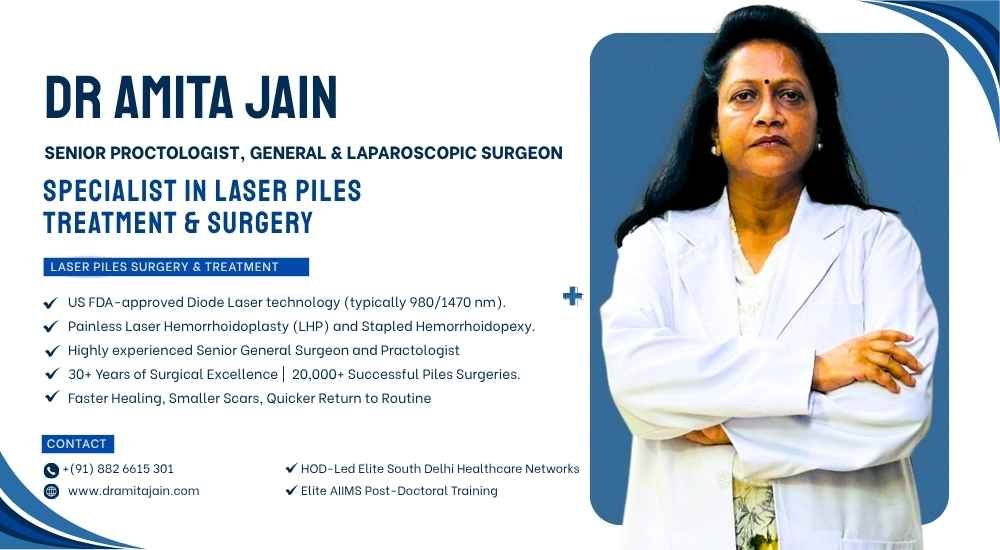
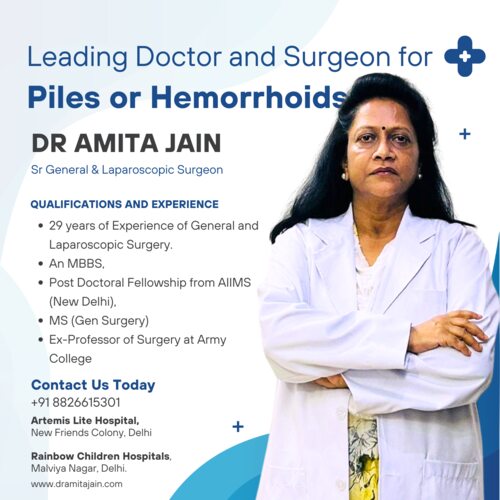
- 29+ Years of Trusted Surgical Mastery: One of Delhi’s most respected senior general, laparoscopic, and colorectal surgeons, holding an MS from Delhi and an AIIMS Post-Doctoral Fellowship.
- Female Colorectal Surgeon Advantage: A significant number of female patients suffer silently with piles for years due to hesitation or fear of examination. Dr Amita Jain offers an empathetic, discreet, and highly dignified clinical environment.
- Advanced Laser & Minimally Invasive Expertise: Specialized training in German diode laser systems, radiofrequency ablation, and stapled hemorrhoidopexy ensures precise, sphincter-sparing outcomes.
- Grade-Specific, Honest Clinical Guidance: Surgery is recommended only when clinically necessary; conservative medical therapy is prioritized for early-stage disease.
- Cashless Mediclaim & Health Insurance Assistance: Seamless hospitalization and hassle-free cashless TPA claims processing across top private hospitals in Delhi NCR.
"With over 29 years of surgical experience—including my time as a frontline military surgeon—I am committed to providing honest, patient-first care. My goal is to offer you the most advanced, US FDA-approved laser treatments that ensure a bloodless, stitchless, and pain-free recovery. We always explore lifestyle changes and medical management first, recommending a procedure only when it is truly essential for your long-term health and comfort."
Dr Amita Jain, Sr General, Proctologist & Laparoscopic Surgeon and one of the Eminent Laser Piles Surgeon in Delhi and India
Expert Hernia Care in South Delhi. Consult Dr Amita Jain Today.
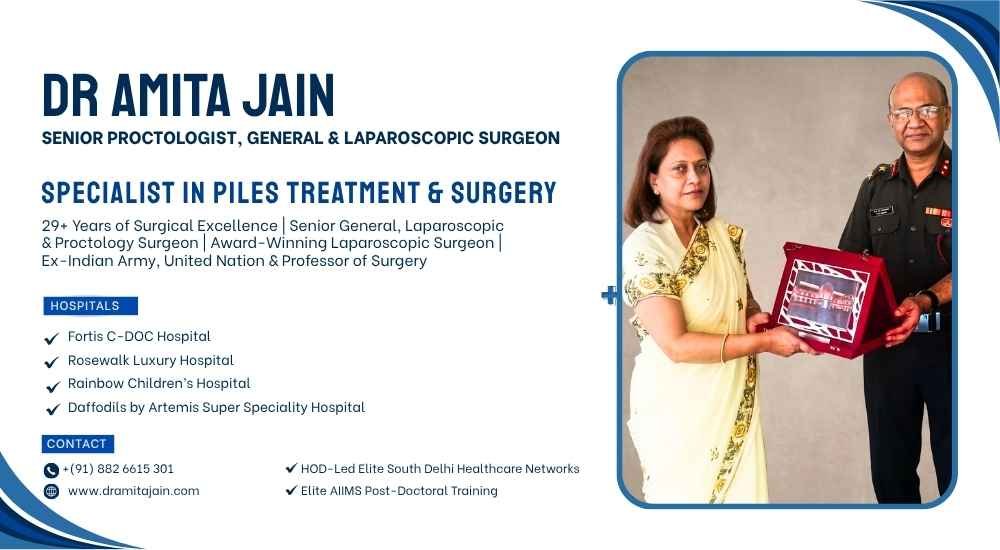
Dr. Amita Jain offers patients the flexibility of specialized surgical care at several premium healthcare facilities across South Delhi. Depending on their specific needs and convenience, patients can choose to be operated on at prestigious locations, including:
- Fortis C-Doc Hospital : OPD, B-16, Nehru Place Flyover, opp. Devika Tower, Chirag Enclave, Greater Kailash, New Delhi, Delhi 110048
- Rosewalk Luxury Maternity Hospital : OPD, N-88, Block N, Panchsheel Park North, Panchsheel Park, New Delhi, Delhi 110017.
- Madhukar Rainbow Children's Hospital : OPD, FC-29 5, Geetanjali Marg, near Malviya Nagar, Block A, Shivalik Colony, Malviya Nagar, New Delhi, Delhi 110017
- Daffodils By Artemis Hospitals: F-44, Block F, East of Kailash, New Delhi, Delhi 110065
- Call to Book Now: +91 8826615301
- WhatsApp for Quick Scheduling: Chat on WhatsApp
Book Your Appointment
Note : Medically Reviewed by Dr. Amita Jain | Senior Surgeon & HOD | Updated September 2026
Piles Treatment & Surgery FAQ
What causes piles to develop?
Piles happen when the blood vessels in the lower rectum and anus become swollen and stretched. This is often triggered by constant straining during bowel movements, chronic constipation, long periods of sitting on the toilet, or pregnancy.
What are the main symptoms of this condition?
The most common signs include painless bleeding during bowel movements, itching or irritation in the anal region, pain or discomfort, and swelling or hard lumps around the anus. If you notice bright red blood in your stool, it is a key indicator to get checked.
How does advanced laser surgery compare to traditional surgery?
Laser surgery is a modern, minimally invasive method that uses targeted laser energy to shrink the swollen tissues. Unlike older surgical methods, it causes very little bleeding, requires no heavy cutting or stitches, and results in significantly less post-surgery pain.
What is the typical recovery time after a laser piles procedure?
Recovery is exceptionally quick because the procedure is gentle on the body. Most patients can walk comfortably within a few hours and return to their normal daily routines and light activities within 24 to 48 hours.
Can lifestyle changes help prevent piles from coming back?
Yes, maintaining healthy habits is essential for long-term relief. Eating a high-fiber diet with plenty of fruits and vegetables, drinking 8 to 10 glasses of water daily, avoiding straining on the toilet, and exercising regularly will keep your bowel movements soft and prevent future swelling.
How does a trauma-trained, Ex-Army surgical background benefit proctology patients?
Anorectal procedures take place in highly sensitive anatomical zones near complex nerve networks and vital sphincter muscles. Applying the rigorous, disciplined background of an Ex-Indian Army surgeon ensures that every procedure is executed with trauma-grade precision, reducing the risk of recurrence and guaranteeing maximum patient safety.
What are the physical risks of delaying advanced treatment for severe piles?
Postponing necessary medical intervention for advanced hemorrhoids can cause dangerous medical complications. Over time, neglected piles can lead to chronic blood loss (anemia), severe localized tissue infections, strangulated prolapses, or painful acute thrombosis, making future surgical management much more difficult.
What complex proctology scenarios require an exceptionally experienced specialist?
Recurrent piles that have failed prior operations, large external masses that interfere with basic personal hygiene, and high-grade prolapses require specialized clinical expertise. Dr Amita Jain utilizes 29 years of advanced general surgery experience to build customized, structured treatment pathways for these difficult scenarios.
Where can patients consult with Dr Amita Jain for painless piles solutions in Delhi NCR?
Dr Amita Jain conducts expert clinical evaluations and performs modern, minimally invasive procedures at leading premium hospitals across South Delhi. Dedicated consultation rooms are accessible to patients by booking appointments at Fortis C-DOC (Chirag Enclave), Rosewalk Hospital (Panchsheel Park), and Madhukar Rainbow Children’s Hospital (Malviya Nagar).