Advanced Appendix & Appendicitis Surgery in Delhi
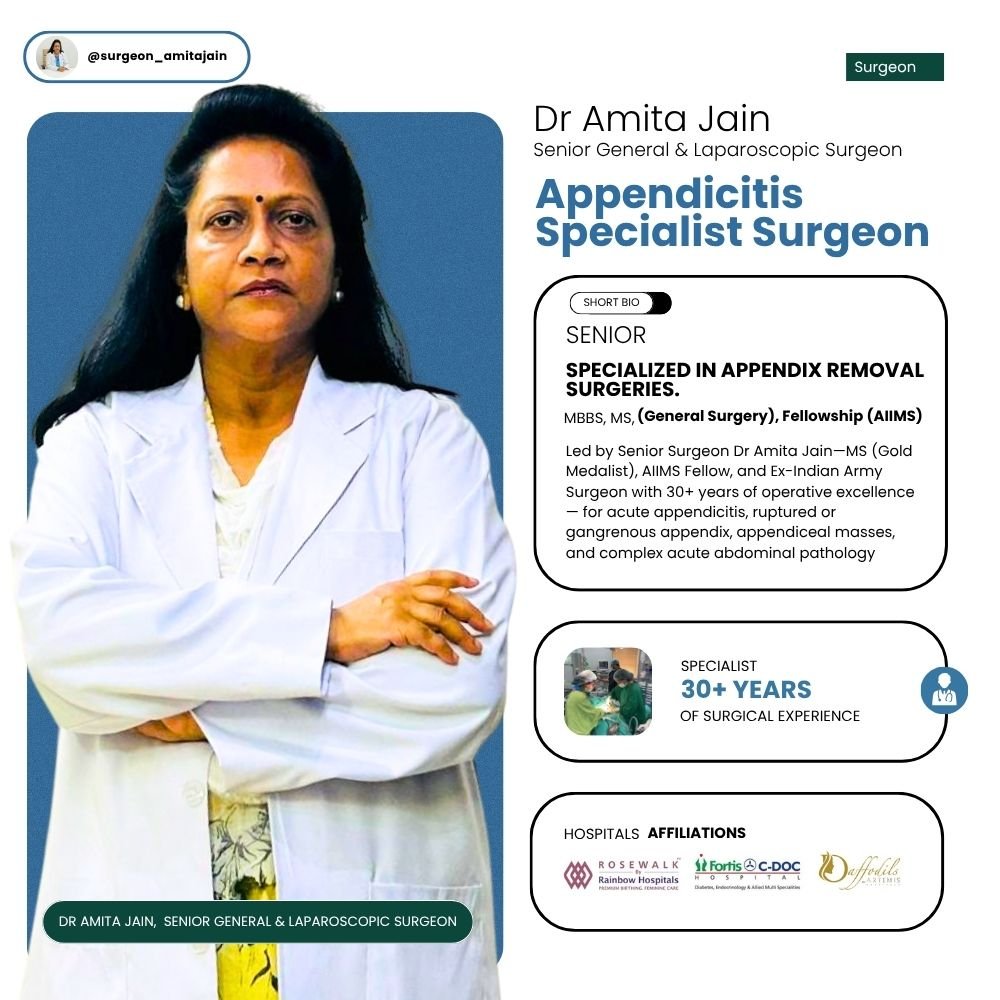
Definitive Laparoscopic, Open & Emergency Appendiceal Surgical Care by Senior Surgeon Dr Amita Jain
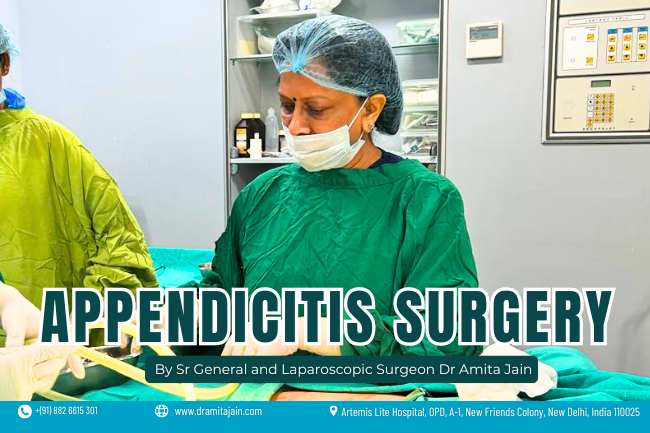
Laparoscopic appendectomy is a minimally invasive surgical procedure performed to remove an inflamed or infected appendix through three tiny 5–10 mm incisions. Using high-definition video laparoscopy, the appendix is safely detached and retrieved, enabling discharge within 24 to 48 hours and resumption of light routine in 5 to 7 days with minimal scarring.
Led by Senior Surgeon Dr Amita Jain—MS (Gold Medalist), AIIMS Fellow, and Ex-Indian Army Surgeon with 30+ years of operative excellence—our surgical department delivers definitive minimally invasive (laparoscopic) and open surgical solutions for acute appendicitis, ruptured or gangrenous appendix, appendiceal masses, and complex acute abdominal pathology. Combining military-grade rapid clinical triage with micro-laparoscopic precision and disciplined open anatomical salvage, we prioritize rapid infection control, patient safety, and fast-track recovery across premier South Delhi hospitals.
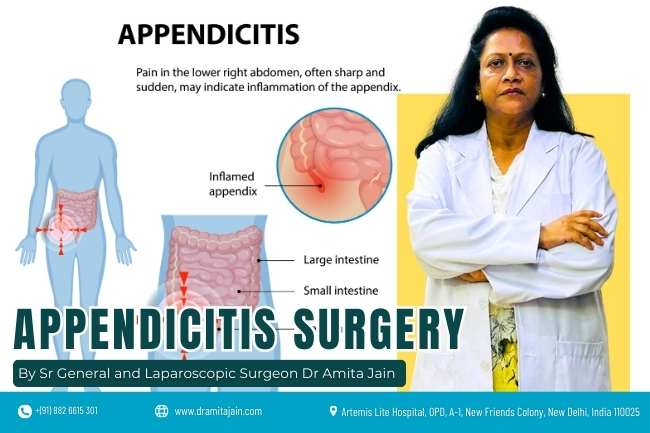
“Appendicitis often begins as vague discomfort near the navel that quickly shifts to sharp pain in the lower right abdomen. Because an inflamed appendix carries the risk of rupture or abscess formation, timely intervention is critical. Our goal is to provide definitive surgical relief before complications arise, ensuring a smooth path to recovery.”
- — Dr Amita Jain, Sr General and Laparoscopic Surgeon, Specialized in Appendix Removal surgeries.
Quick Summary for Patients
Surgeon: Dr Amita Jain — MBBS, MS (General Surgery, Gold Medallist), AIIMS Post-Doctoral Fellow, Ex-Indian Army Surgeon (30+ Years Surgical Experience).
Education & Credentials:
- MBBS: NSCB Govt. Medical College, Jabalpur (MP)
- MS (General Surgery – Gold Medalist): NSCB Govt. Medical College, Jabalpur (MP)
- Fellowship: Post-Doctoral Fellow, All India Institute of Medical Sciences (AIIMS, New Delhi)
Medical Registration Number: 10883
Academic Appointments:
Professional Memberships:
Care Model: Rapid Clinical Triage (Alvarado & AIR Scoring), High-Precision Laparoscopic (Keyhole) Appendectomy, Direct Tactile Open Appendectomy for Complicated Presentations, Evidence-Based 2-Stage Protocol for Appendiceal Abscesses, Sterile Peritoneal Lavage for Peritonitis, and an ERAS Fast-Track Recovery Pathway.
Procedures Offered:
- Emergency Laparoscopic Appendectomy (Keyhole Appendicectomy)
- Open Appendectomy (Conventional / Direct Anatomical Plane Access)
- Emergency Trauma Laparoscopy & Peritoneal Lavage for Ruptured / Perforated Appendix
- Image-Guided Drainage & Targeted Antibiotic Care for Appendiceal Abscess / Mass
- Planned Interval Appendectomy (Staged Secondary Surgery at 6–8 Weeks)
- Resection for Suppurative & Gangrenous Appendicitis
- Diagnostic Laparoscopy for Atypical Right Lower Quadrant / Acute Abdominal Pain
Consultation Centers: Fortis C-DOC (Chirag Enclave / Nehru Place) | Rosewalk Hospital (Panchsheel Park) | Rainbow Children’s Hospital (Malviya Nagar) | Daffodils by Artemis (East of Kailash).
Appendicitis is a progressive, time-sensitive medical condition characterized by the sudden inflammation of the vermiform appendix, a small, blind-ended pouch originating from the cecum near the junction of the small and large intestines. When obstruction of the appendiceal lumen occurs, naturally occurring bacteria multiply rapidly, leading to pus accumulation, severe localized swelling, and an escalating risk of organ perforation.
Dr Amita Jain provides comprehensive, evidence-based surgical management for all clinical manifestations of appendix pathology in Delhi. Earning her foundational expertise during years of high-stress service as a frontline trauma surgeon in the Indian Army, Dr Jain applies strict protocol-driven precision, steady clinical decision-making, and advanced minimally invasive keyhole techniques to ensure patient safety and rapid functional recovery.
South Delhi Surgical Infrastructure and Operating Facilities
For patient accessibility and to ensure access to advanced laparoscopic technology, Dr Amita Jain conducts elective and emergency surgeries across premium, accredited tertiary healthcare centers in South Delhi. These advanced operative suites are fully equipped with high-definition laparoscopic towers, specialized micro-instrumentation, and comprehensive critical care monitoring systems. Clinical care and surgical procedures are systematically distributed across the following regional network points:
- Fortis C-Doc Hospital: Situated at Chirag Enclave, directly opposite Devika Tower near the Nehru Place Flyover, serving residents across Greater Kailash, Kalkaji, Chittaranjan Park, Alaknanda, and adjacent South Delhi neighborhoods.
- Madhukar Rainbow Children's Hospital: Located at Shivalik Colony on Geetanjali Marg, near Malviya Nagar, providing a specialized environment optimized for advanced pediatric and adolescent appendix treatments, serving families from Saket, Hauz Khas, and Sainik Farms.
- Rosewalk Multi-Specialty Hospital: Situated at Panchsheel Park North, offering a premium clinical setup for advanced general surgery and minimally invasive laparoscopy, serving patients from Green Park, Safdarjung Development Area, and Gulmohar Park.
- Daffodil Artemis Hospital: F-44, Block F, East of Kailash, New Delhi, Delhi 110065

Appendix Pathophysiology, Clinical Triage & Risk Stratification
Appendicitis is a progressive, time-sensitive surgical emergency caused by the acute blockage of the appendiceal lumen (by a fecalith, lymphoid swelling, or foreign body). Trapped mucosal secretions lead to rapid bacterial multiplication, intramural swelling, vascular thrombosis, and eventual tissue necrosis or wall rupture.
"The most dangerous attribute of appendiceal progression is its unpredictable timeline. A patient presenting with vague indigestion or mild peri-umbilical discomfort in the morning can easily progress to acute luminal swelling, localized right lower quadrant distress, or an imminent gangrenous rupture by nightfall. Early diagnostic evaluation through proper tracking of clinical tender points and leukocyte activity is the key to executing a safe, clean, minimally invasive laparoscopic removal before complications occur."
— Dr Amita Jain, Sr General, Proctologist & Laparoscopic Surgeon, Fortis C-DOC, Rosewalk Hospital, Rainbow and Daffodil Artemis Hospital.
Protocol-Driven Appendix Surgery: Laparoscopic, Open & Staged Management
Every presentation of appendicitis is unique—ranging from simple acute inflammation to complex, friable inflammatory phlegmons. Drawing on decades of clinical experience and frontline trauma expertise from the Indian Army, Dr Amita Jain applies tailored surgical protocols:
| Pathology Stage |
Underlying Clinical Presentation |
Target Surgical Protocol |
| Acute Appendicitis |
Sudden structural blockage causing early luminal swelling. |
Prompt Laparoscopic Appendectomy: Immediate keyhole removal through micro-incisions. |
| Suppurative Appendicitis |
Advanced purulent progression filling the pouch with pus. |
Laparoscopic Clearance and Drainage: Minimally invasive removal and thorough cleaning. |
| Gangrenous Appendicitis |
Severe swelling cuts off blood supply, causing rapid necrosis. |
Emergency Trauma Laparoscopy: High-priority resection to halt systemic toxicity. |
| Perforated / Ruptured Appendix |
Wall collapse spreading infectious material throughout the abdomen. |
Urgent Appendectomy with Peritoneal Washing: Removal and sterile peritoneal lavage. |
| Appendiceal Abscess / Mass |
Subacute leak walled off by the body's natural defenses. |
2-Stage Staged Care: Image-guided drainage, antibiotics, and planned Interval Appendectomy. |
Complex Cases, Peritonitis & Staged Care
Managing Peritonitis and Ruptures: A perforated appendix leads to generalized peritonitis. Dr Jain utilizes a systematic trauma surgical approach: complete appendix resection combined with extensive peritoneal washing using warmed sterile saline to eliminate hidden infection pockets and prevent post-operative inter-loop abscesses.
The 2-Stage Strategy for Appendiceal Abscess / Phlegmon: Attempting an immediate emergency operation on a dense, friable appendiceal mass risks inadvertent injury to adjacent healthy small bowel. Dr Jain stabilizes these cases first with image-guided percutaneous drainage and targeted IV antibiotics. Once the inflammatory mass has completely resolved, an elective Interval Appendectomy is performed 6 to 8 weeks later in clean, safe tissue planes.
The Military Trauma Advantage: Navigating an inflamed retrocecal appendix, dense post-inflammatory adhesions, or severe anatomical variations requires steady tactile judgment. Dr Jain’s military surgical discipline ensures minimal tissue trauma, zero spillage, and secure appendiceal stump closure.
Protocol-Driven Management of Complex Appendix Conditions by Dr Amita Jain
While standard laparoscopic keyhole surgery is the routine choice for early-stage inflammation, advanced appendix conditions require specialized care. Drawing on her extensive experience as a former Indian Army Trauma Surgeon, Dr Amita Jain applies decades of clinical expertise to determine when an immediate emergency operation is mandatory and when a non-surgical, medical approach must be prioritized for patient safety:
- Acute Appendicitis Treatment: Focused on immediate keyhole intervention during the critical early window to prevent structural tissue breakdown and ensure a fast 24-to-48-hour recovery.
- Appendiceal Abscess Appendix Management: This condition does not receive immediate surgery. Attempting an emergency operation on a dense, highly inflamed appendiceal mass can be dangerous, as it increases the risk of injuring the nearby healthy bowel. Instead, Dr Jain utilizes a disciplined, non-surgical medical approach first. The active infection is controlled through image-guided external drainage paired with targeted intravenous antibiotics. A planned interval appendectomy is only scheduled 6 to 8 weeks later as a secondary precautionary step once the local tissues have completely healed under safe conditions.
- Gangrenous Appendicitis Treatment: Emergency surgical intervention designed for rapid tissue resection when rising internal pressure compromises blood supply and causes tissue death.
- Perforated (Ruptured) Appendicitis Treatment: High-priority emergency trauma laparoscopy where her background in complex abdominal trauma is vital for executing meticulous infection control, surgical removal, and extensive peritoneal cleaning to treat widespread peritonitis.
- Suppurative Appendicitis Treatment: Targeted surgical removal and fluid clearance designed to safely extract the appendix when it has become severely swollen and entirely filled with active pus.
Detailed Clinical Walkthrough of Complex Appendiceal Conditions
The Critical Progression of Suppurative and Gangrenous Tissue
When an acute obstruction is left unaddressed for more than twenty-four hours, the biological environment within the appendiceal lumen changes rapidly. In the suppurative stage, the internal pressure causes the tissue walls to stretch, trapping fluids and blocking the natural drainage of local veins. This leads to a severe buildup of pus.
If the inflammation continues without surgical intervention, it progresses into gangrenous appendicitis. At this point, the rising pressure cuts off the arterial blood supply entirely, resulting in tissue death (necrosis). A gangrenous appendix is highly unstable and can rupture at any moment, making immediate laparoscopic removal critical to prevent life-threatening abdominal complications.
Managing Perforated Presentations and Peritonitis
A perforated or ruptured appendix represents a severe surgical emergency. When the structural wall of the appendix collapses, it releases bacteria, stagnant pus, and fecal matter directly into the sterile abdominal cavity. This spillage causes peritonitis, a widespread infection and inflammation of the abdominal lining.
Patients with a ruptured appendix experience severe, unremitting abdominal pain, rigid abdominal muscles, a high fever, and systemic toxicity. Treating this condition requires a meticulous laparoscopic approach. The surgical team must thoroughly clean and irrigate the entire peritoneal cavity with sterile saline solution to eliminate hidden pockets of infection, minimize post-operative abscesses, and protect the surrounding bowel loops.
The Staged Treatment Approach for Appendiceal Abscesses and Masses
In some instances, a patient's immune system successfully walls off a localized appendix leak before it can spread throughout the abdomen. This defense mechanism forms an appendiceal abscess (a localized pocket of pus) or an appendiceal mass (an inflammatory lump of tissue involving the surrounding small intestine and omentum).
Attempting an immediate emergency operation on a dense, highly inflamed appendiceal mass can be dangerous, as it increases the risk of injuring the nearby healthy bowel. Dr Amita Jain addresses these complex cases using a sophisticated, evidence-based two-stage strategy.
First, the active infection is controlled through image-guided external drainage paired with targeted intravenous antibiotics. Once the internal inflammation completely subsides, a planned interval appendectomy is scheduled six to eight weeks later. This staged approach allows for a clean, minimally invasive keyhole removal of the remaining appendix tissue under much safer conditions.
The Military Advantage in Complex Abdominal Pathology
Operating on an inflamed appendix demands exact tissue identification and careful handling, particularly with anatomical variations or late-stage complications. Dr Amita Jain leverages her background as a former Indian Army Surgeon to manage these scenarios with protocol-driven precision. Whether addressing dense adhesions, a retrocecal appendix position, or managing a peritonitis emergency, her experience ensures meticulous intra-operative control and enhanced patient safety.
Post-Operative ERAS Fast-Track Recovery Pathway
Consultation Centers Across Delhi
- Fortis C-Doc Hospital : OPD, B-16, Nehru Place Flyover, opp. Devika Tower, Chirag Enclave, Greater Kailash, New Delhi, Delhi 110048
- Rosewalk Luxury Maternity Hospital : OPD, N-88, Block N, Panchsheel Park North, Panchsheel Park, New Delhi, Delhi 110017.
- Madhukar Rainbow Children's Hospital : OPD, FC-29 5, Geetanjali Marg, near Malviya Nagar, Block A, Shivalik Colony, Malviya Nagar, New Delhi, Delhi 110017
- Daffodils By Artemis Hospitals: F-44, Block F, East of Kailash, New Delhi, Delhi 110065
- Call to Book Now: +91 8826615301
- WhatsApp for Quick Scheduling: Chat on WhatsApp
Consult Dr Amita Jain
FAQ for Appendicitis Treatments and Surgeries
How do I know if my stomach pain is appendicitis?
Stomach pain from appendicitis usually starts around the belly button and shifts to the lower right side of the abdomen, often accompanied by nausea, vomiting, loss of appetite, and low-grade fever. Leading appendix surgeon in Delhi Dr Amita Jain advises that any sudden, severe abdominal pain should be evaluated promptly. Consulting a top appendix specialist like Dr Amita Jain ensures accurate diagnosis and helps distinguish appendicitis from other digestive issues. To know what are the signs of appendix pain, read here.
Can appendicitis get worse if untreated?
Yes, untreated appendicitis can rapidly worsen and lead to serious complications such as a ruptured appendix, peritonitis, or abscess formation. Top appendix specialist in Delhi Dr Amita Jain emphasizes that delaying treatment increases the risk of life-threatening emergencies. Seeking care from a leading appendix surgeon such as Dr Amita Jain at the first sign of symptoms is critical for safe and timely management.
How quickly does appendicitis become an emergency?
Appendicitis can become an emergency within 24 to 48 hours if the inflammation progresses and the appendix ruptures. Best appendix doctor in Delhi Dr Amita Jain explains that early recognition and prompt surgical intervention significantly reduces complications and improve recovery outcomes.
Is surgery always needed for appendicitis?
Surgery, specifically an appendectomy, is the most effective and permanent treatment for appendicitis. While antibiotics may be used temporarily in select cases, leading appendix surgeon in Delhi Dr Amita Jain notes that most patients require surgery to prevent recurrence and avoid dangerous complications. Consulting the best appendix specialist in India like Dr Amita Jain ensures that patients receive safe and advanced care tailored to their condition.
Where exactly does appendicitis pain start, and how does it move?
Appendicitis pain typically begins as a dull, vague discomfort located directly around the belly button. Over the course of 12 to 24 hours, this discomfort shifts and intensifies into a sharp, localized pain in the lower right side of the stomach. The pain becomes significantly worse when coughing, walking, or making sudden movements.
What causes the appendix to become inflamed in the first place?
The condition occurs when the narrow, finger-like pouch gets blocked internally. This blockage is most commonly caused by a small piece of hard, calcified stool, but it can also happen due to swollen lymph nodes from a viral infection, or foreign materials. Once blocked, naturally occurring bacteria get trapped inside, multiplying rapidly and causing the organ to swell with pus.
Can antibiotics alone cure appendicitis without undergoing an operation?
While certain mild or uncomplicated cases can temporarily respond to intravenous antibiotics, surgery remains the standard and safest cure. Treating it with medicine alone carries a very high risk of the infection returning in the future, because the original physical blockage inside the pouch remains unresolved.
What happens if an inflamed appendix bursts inside the body?
If left untreated for more than 24 to 72 hours, the severe swelling cuts off blood supply, causing the tissue to break open or rupture. A burst releases highly infectious material and bacteria into the abdominal cavity, leading to a serious, life-threatening lining infection called peritonitis, which requires emergency open or laparoscopic cleaning.
How do specialists definitively diagnose appendicitis during an emergency visit?
Doctors utilize a combination of specific clinical checks and emergency diagnostics. This includes checking for rebound tenderness during a physical examination, performing blood tests to check for elevated infection markers, and conducting a rapid abdominal ultrasound or CT scan to visualize the swelling.
What are the key benefits of choosing laparoscopic surgery over open surgery?
Laparoscopic appendix removal is a minimally invasive technique where the surgeon operates through three tiny incisions using a camera and specialized tools. Compared to a large open incision, this keyhole approach results in drastically less post-operative pain, minimal localized scarring, a lower risk of wound infection, and a significantly faster return to normal daily routines.
How long is the hospital stay and recovery time after a keyhole appendix operation?
For a standard, unruptured case, patients are typically discharged from the hospital within 24 to 48 hours after the procedure. Most individuals can return to light walking and sedentary desk work within 5 to 7 days, though heavy lifting, intense workouts, and strenuous activities should be avoided for 2 to 3 weeks until internal tissue completely heals.
Are there any long-term digestive changes or dietary restrictions after removing the appendix?
No, the human body functions perfectly well without it, as it does not play a critical role in adult digestion. Once the surgical recovery period is over, the digestive system processes food normally, and patients can return to their regular daily diet without any long-term restrictions.
Why does a complex or ruptured appendix require a highly skilled surgeon?
Complicated presentations—such as a gangrenous appendix, localized abscess collections, or a fully ruptured appendix with spreading infection—demand advanced surgical expertise. Dr Amita Jain leverages her 29+ years of experience to carefully navigate dense tissue inflammation, perform thorough abdominal washouts, and safely remove the diseased tissue while protecting the surrounding intestines.
Where can patients consult with Dr Amita Jain for advanced appendix care in Delhi?
Dr Amita Jain provides expert emergency evaluations and advanced laparoscopic procedures at leading medical centers in New Delhi. Patients can book appointments to see her at Fortis C-DOC (Chirag Enclave), Rosewalk Hospital (Panchsheel Park), and Madhukar Rainbow Children’s Hospital (Malviya Nagar).