Advanced General & Open Surgery in Delhi
Definitive Visceral, Abdominal Wall, Endocrine, Breast & Complex Soft Tissue Surgical Care by Senior Surgeon Dr Amita Jain
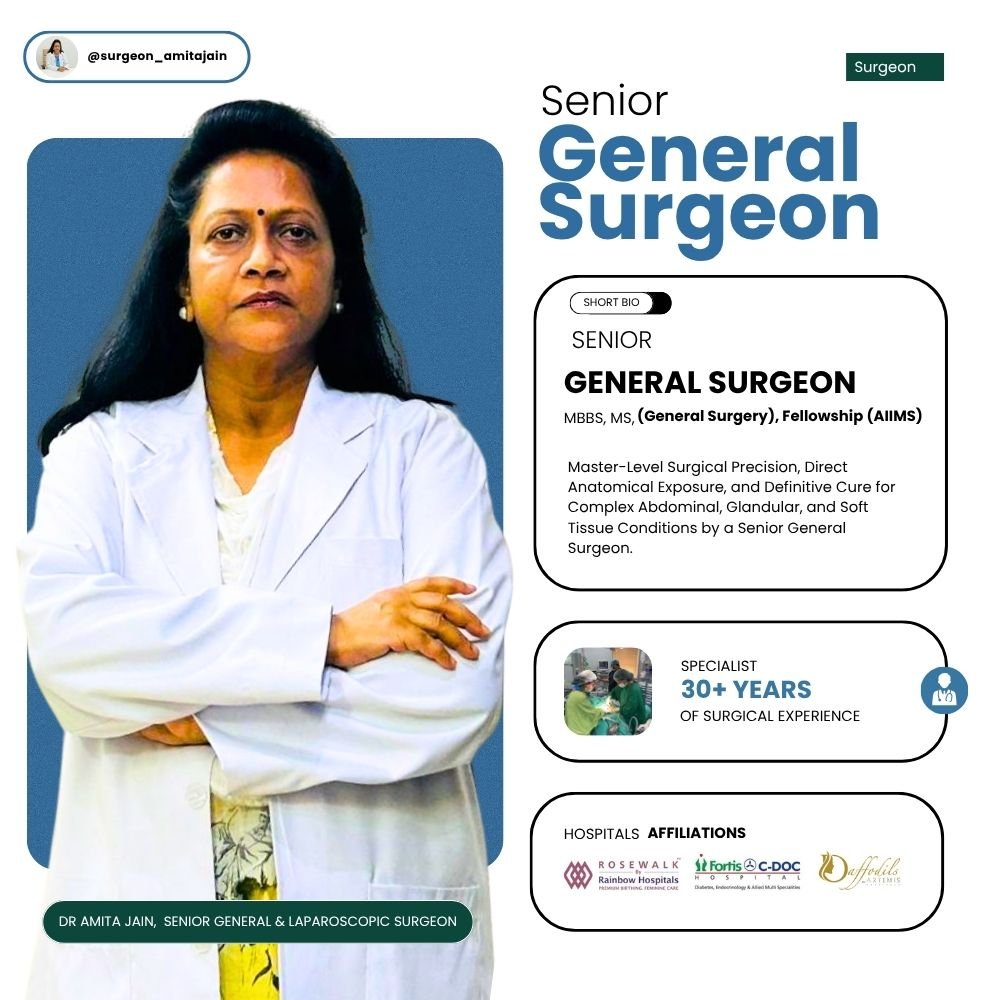
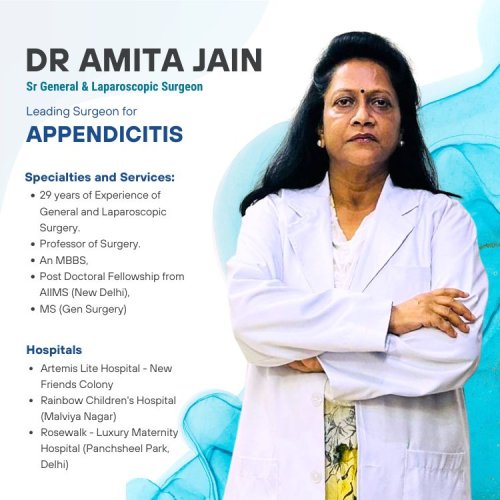
Led by Senior Surgeon Dr Amita Jain—MS (Gold Medalist), AIIMS Fellow, and Ex-Indian Army Surgeon with 30+ years of operative excellence—our department delivers definitive open and general surgical solutions for complex abdominal wall hernias, visceral diseases, endocrine pathology, and soft tissue disorders. Combining direct tactile precision with disciplined anatomical reconstruction, we prioritize tissue preservation, patient safety, and durable long-term recovery across premier South Delhi hospitals.
Surgeon: Dr Amita Jain
MBBS, MS (General Surgery, Gold Medallist), AIIMS Post-Doctoral Fellow, Ex-Indian Army Surgeon (30+ Years Surgical Experience).
Education & Credentials:
- MBBS: NSCB Govt. Medical College, Jabalpur (MP)
- MS (General Surgery – Gold Medalist): NSCB Govt. Medical College, Jabalpur (MP)
- Fellowship: Post-Doctoral Fellow, All India Institute of Medical Sciences (AIIMS, New Delhi)
- Medical Registration Number: 10883
Professional Memberships
- The Association of Surgeons of India (ASI) — Life Fellow Member No: FL 9945
- Association of Minimal Access Surgeons of India (AMASI) — Member No: 10314
Care Model
Definitive Open Surgical Access, Direct Tactile Precision, Strict Anatomical Plane Dissection, Tension-Free Layered Closure, Evidence-Based ERAS Pathway, Multimodal Pain Management, and Predictable In-Hospital Recovery.
Procedures Offered
Complex Abdominal Wall Hernia Reconstruction (Open Inguinal, Umbilical, Ventral & Incisional Hernia Repair with Retromuscular/Sublay Mesh Plasty), Open Cholecystectomy, Open Appendectomy, Exploratory Laparotomy & Bowel Resection-Anastomosis, Open Thyroidectomy (Hemi & Total), Breast Surgery (Lumpectomy, Fibroadenoma Excision, Microdochectomy), Definitive Anorectal Surgery (Excisional Hemorrhoidectomy, Fistulotomy, Fistulectomy, Sphincterotomy, Pilonidal Sinus Excision/Flap), Lipoma & Soft Tissue Tumor Enucleation, and Advanced Wound Debridement & Flap Coverage.
Meet Dr Amita Jain: Senior General Surgeon in Delhi
General surgery is the definitive medical discipline for treating diseases of the body's vital organ systems—ranging from abdominal visceral disorders and complex muscle wall defects to intricate glandular and soft tissue conditions. While modern surgical access routes vary, classical open surgery remains the definitive foundation for complex, deep-seated, recurrent, or anatomically challenging cases where direct visualization, tactile tissue feedback, and complete margin control are critical to surgical success.
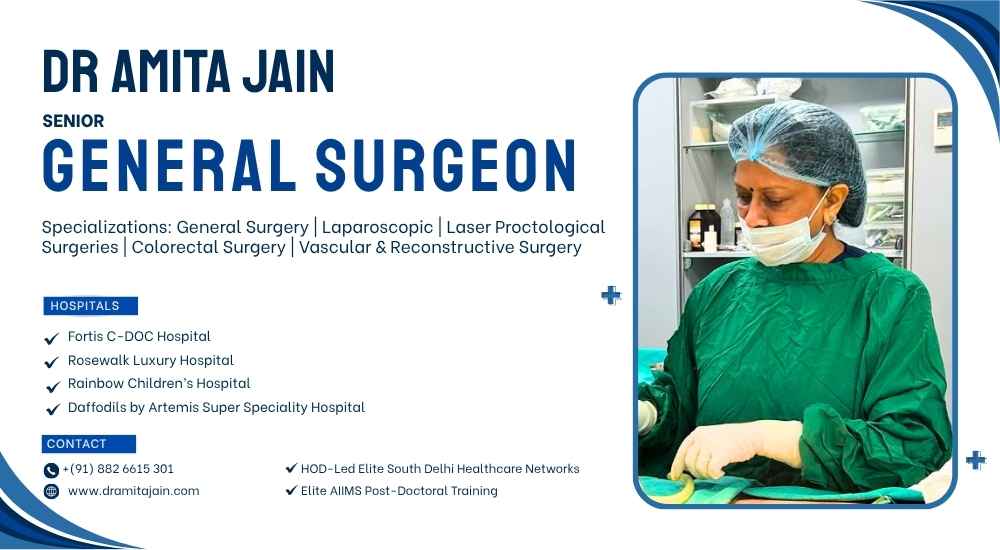
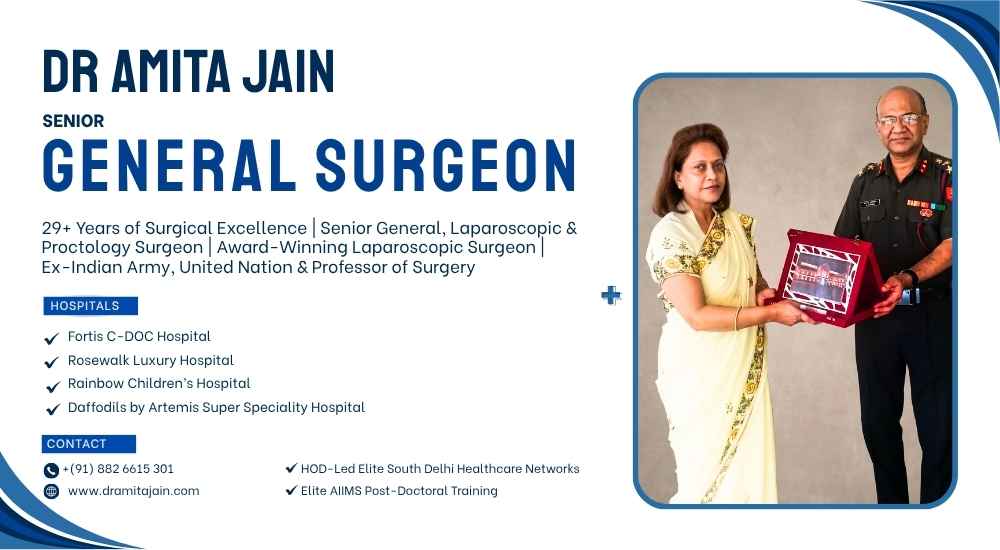
As Head of Department across premier South Delhi tertiary healthcare networks, Dr Amita Jain brings nearly three decades of surgical mastery to both elective interventions and urgent surgical emergencies. An MS in General Surgery (Gold Medalist), an AIIMS Post-Doctoral Fellow, and an Ex-Professor of Surgery who has trained generations of surgical postgraduates, Dr Jain integrates deep academic rigor with hands-on operative mastery.
Her surgical technique was further refined during her distinguished service as an Indian Army Surgeon in the Armed Forces Medical Services. Her practice emphasizes a disciplined, systematic approach to the isolation of diseased tissues, the meticulous preservation of major blood vessels, and secure, layered tissue closure. This rigorous discipline minimizes intraoperative tissue trauma, controls bleeding, and provides a standardized surgical safety baseline that significantly reduces the risk of postoperative complications.
"General surgery is the definitive discipline for treating diseases of the body's vital core systems—ranging from hidden abdominal emergencies to intricate glandular and soft tissue reconstructions. True surgical excellence requires the ability to interpret subtle structural symptoms early, choose the safest surgical pathway, and execute it with absolute precision to preserve healthy tissue and protect patient life."
- Dr Amita Jain, Senior General Surgeon, Fortis C-DOC, Rosewalk Luxury Hospital, and Daffodils by Artemis Super Speciality Hospital
The Clinical Value of Open Surgery in General Surgical Practice
In an era of evolving technology, open general surgery remains the indispensable gold standard for definitive anatomical repair:
- Direct Tactile Assessment: Open access allows the surgeon to directly palpate deep organ tissues, identifying subtle structural changes, hidden fibrous nodules, or dense tissue thickening that cannot be felt through instruments.
- Superior Exposure in Distorted Anatomy: For patients with extensive internal scar tissue (adhesions) from prior surgeries or chronic inflammation, open surgery provides direct visual and manual control, significantly reducing the risk of accidental injury to adjacent bowels or blood vessels.
- Definitive Margin Clearance: For glandular swellings, deep breast lumps, complex infected tracts, or soft tissue tumors, open surgical dissection ensures complete, en-bloc removal with clear, healthy anatomical margins.
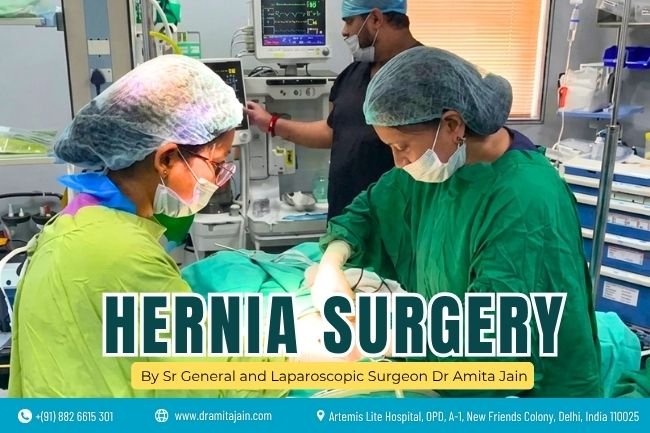
- Durable, Tension-Free Structural Reconstruction: In large, recurrent, or incisional abdominal wall hernias, open surgery permits specialized anatomical releases (such as component separation) and stable placement of prosthetic mesh in deep retromuscular or pre-peritoneal tissue planes, ensuring lasting structural repair.
Master Directory of General Surgical Conditions & Procedures
Dr Amita Jain provides comprehensive surgical assessment and definitive open surgical management across five key anatomical categories:
| Surgical Category |
Specific Conditions Treated |
Clinical Presentation |
Definitive Open Surgical Modality |
| Abdominal Wall & Groin Defects |
- Inguinal Hernia (Direct & Indirect)
- Umbilical & Paraumbilical Hernia
- Ventral & Incisional Hernias
- Large Recurrent Hernias
|
Visible bulge in the groin or abdomen that enlarges with coughing/standing; persistent dragging sensation; risk of intestinal entrapment. |
- Open Lichtenstein Tension-Free Mesh Plasty
- Retromuscular / Sublay Mesh Repair
- Anatomical Component Separation Technique for large abdominal wall defects
|
| Visceral & Core Abdominal |
- Symptomatic Gallstones & Cholecystitis
- Acute Appendicitis
- Intestinal Obstruction & Adhesions
- Visceral Perforation / Peritonitis
|
Severe upper right abdominal colic, lower right quadrant pain, abdominal distension, fever, vomiting, and inability to pass flatus. |
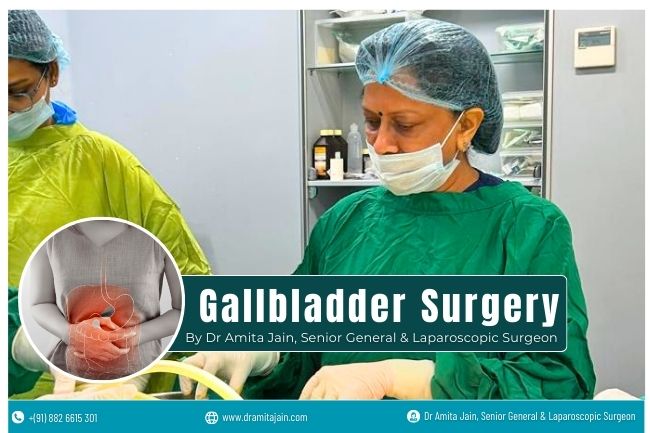
- Open Cholecystectomy (Planned or for severe scarring)
- Open Appendectomy
- Exploratory Laparotomy, Adhesiolysis & Resection-Anastomosis
|
| Endocrine & Glandular Pathology |
- Multinodular Goiter & Thyroid Nodules
- Solitary Thyroid Adenomas
- Male Gynecomastia
|
Visible neck swelling, choking sensation on lying flat, difficulty swallowing, enlarged glandular male breast tissue. |
- Open Hemithyroidectomy / Total Thyroidectomy (with Nerve & Parathyroid Preservation)
- Subcutaneous Mastectomy / Open Gland Excision
|
| Breast & Soft Tissue Pathology |
- Fibroadenomas & Benign Breast Lumps
- Mammary Duct Ectasia & Papillomas
- Giant Lipomas & Sebaceous Cysts
|
Palpable, movable breast masses; abnormal nipple discharge; localized subcutaneous fatty or cystic lumps on the body or limbs. |
- Open Lumpectomy / Wide Local Excision
- Microdochectomy / Hadfield's Operation
- Complete Surgical Capsule Enucleation & Excision
|
| Definitive Anorectal Surgery |
- Severe Grade 3 & 4 Piles (Hemorrhoids)
- Complex Fistula-in-Ano
- Chronic Anal Fissure
- Pilonidal Sinus Disease
|
Painless rectal bleeding, prolapsed anal vascular cushions, recurrent perianal pus drainage, severe defecation pain, tailbone tracts. |
- Open Excisional Hemorrhoidectomy (Milligan-Morgan)
- Fistulotomy, Fistulectomy & Seton Placement
- Lateral Internal Sphincterotomy (LIS)
- Excision with Primary Closure or Limberg Flap
|
| Complex Wounds & Vascular Conditions |
- Non-Healing Diabetic Foot Ulcers
- Deep Bedsores (Pressure Ulcers)
- Surface Malignancies / Skin Growths
- Symptomatic Varicose Veins
|
Chronic skin breakdown over bony areas, non-healing foot sores, ulcerated skin nodules, painful ropy leg veins. |
- Surgical Debridement & Negative Pressure Wound Therapy (VAC)
- Split-Thickness Skin Grafting (STSG) & Flap Coverage
- Wide Local Excision with Safe Margins
- Open Trendelenburg Ligation & Stripping / Phlebectomy
|
Clinical Decision Matrix: When Open Surgery is the Recommended Choice
The surgical approach is chosen based on patient safety, tissue characteristics, and the need for durable repair:
| Clinical Condition |
Primary Open Surgical Approach |
Key Rationale for Choosing Open Surgery |
| Complex or Recurrent Incisional Hernia |
Open Retromuscular (Sublay) Mesh Plasty |
Allows the surgeon to separate muscular planes directly, release tight lateral muscles, and anchor a large mesh securely behind the muscle, helping prevent recurrence. |
| Complicated Cholecystitis with Dense Fibrosis |
Open Cholecystectomy (Primary or Planned Conversion) |
Severe inflammation can obscure critical biliary anatomy. Direct palpation and visual exposure help identify the common bile duct and cystic artery safely, reducing the risk of bile duct injury. |
| Enlarged Thyroid Goiter or Suspicious Nodule |
Open Thyroidectomy |
Provides direct visualization to identify and protect the recurrent laryngeal nerves and parathyroid glands, helping preserve voice function and calcium balance. |
| Severe Grade 4 / External Piles |
Open Excisional Hemorrhoidectomy |
Enables complete surgical removal of internal vascular cushions and extensive external skin tags, helping address residual or recurrent disease. |
| Deep Non-Healing Pressure Ulcers / Bedsores |
Radical Surgical Debridement & Flap Coverage |
Allows thorough removal of non-viable, infected soft tissue and bone, preparing a healthy vascular base for flap reconstruction. |
Clinical Identification: Signs That Require a General Surgical Evaluation
Early evaluation allows for planned, elective treatment and helps prevent emergency complications. Schedule a surgical consultation if you experience:
- A Visible or Palpable Lump: A new, growing, or tender lump in the groin, near the belly button, under a previous surgical scar, within the breast tissue, or on the neck.
- A Protrusion That Changes with Position: A bulge in the abdomen or groin that enlarges while standing, coughing, or lifting, and disappears when lying flat (a characteristic sign of an abdominal wall hernia).
- Persistent Abdominal Pain: Colicky pain in the upper right abdomen after eating, persistent discomfort in the lower right abdomen, abdominal fullness, or unexplained changes in bowel habits.
- Anorectal Symptoms: Bleeding during bowel movements, tissue protruding through the anal opening, persistent itching, or recurring fluid drainage near the anus or tailbone.
- Chronic Non-Healing Skin Wounds: Sores on the lower legs or feet that fail to heal, pressure breakdown over the hips or tailbone, or painful, enlarged superficial veins in the legs.
Surgical Warning Signs: When to Seek Immediate Emergency Attention
Seek emergency surgical care immediately if you develop any of the following acute warning signs:
- The Acute Abdomen (Peritoneal Inflammation): Sudden, severe, agonizing abdominal pain accompanied by a rigid, board-like abdomen, high fever, continuous vomiting, and the inability to pass flatus or stool.
- Strangulated or Incarcerated Hernia: An abdominal or groin bulge that suddenly becomes firm, intensely painful, discolored (turning red, purple, or dark), and can no longer be gently reduced back inside, often accompanied by severe nausea.
- Infected Wound or Tissue Crisis: Rapidly spreading redness, intense heat, skin blistering, or blackening around a chronic ulcer, bedsore, or diabetic wound, accompanied by high fever or chills.
Structured Diagnostic & Pre-Operative Workup Protocol
To ensure procedural safety and optimal surgical outcomes, Dr Amita Jain follows a standardized 5-step evaluation protocol:
- Step 1 — Comprehensive Clinical Examination: Detailed review of the patient's symptoms, past medical history, prior abdominal operations, current medications (especially antiplatelet or anticoagulant agents), and a physical examination of the affected anatomical area.
- Step 2 — Diagnostic Imaging & Tissue Assessment:
- High-Resolution Abdominal Ultrasound: Evaluates gallbladder wall thickness, gallstones, biliary duct diameter, and groin structures.
- Contrast-Enhanced CT (CECT) of the Abdomen: Maps out complex abdominal wall hernias, delineates internal adhesions, and clarifies bowel obstructions.
- High-Definition Sonomammography & FNAC/Biopsy: Accurately characterizes breast masses and thyroid nodules prior to definitive surgical excision.
- Step 3 — Pre-Operative Laboratory Testing: Complete Blood Count (CBC), Coagulation Profile (PT/INR), Kidney Function Tests (KFT), Liver Function Tests (LFT), and Glycated Hemoglobin (HbA1c) optimization.
- Step 4 — Pre-Anesthetic Clearance (PAC): Comprehensive cardiovascular, pulmonary, and systemic assessment to select the safest anesthesia approach (General, Spinal, or Monitored Local Anesthesia).
- Step 5 — Tailored Procedure Planning: Detailed discussion with the patient regarding the planned incision, the type of mesh or closure to be used, expected recovery timelines, and postoperative wound care.
Post-Operative Care & Recovery Roadmap for Open Surgery
Recovery after open general surgery follows a clear, structured healing timeline:
Days 0 to 2 (Hospital Care & Early Mobility):
- Continuous monitoring of vital signs, fluid balance, and the surgical site.
- Multimodal pain management (wound-site nerve blocks and oral analgesics) to support comfort.
- Assisted bedside sitting and gentle walking started within 12 to 24 hours.
- Oral liquids initiated once normal bowel motility returns, transitioning gradually to soft foods.
Days 3 to 5 (Hospital Discharge & Early Home Recovery):
- Discharge once walking comfortably, tolerating a solid diet, and passing regular bowel movements.
- Dressing inspection before discharge; clear home care guidelines and oral medications provided.
- Stool softeners prescribed to eliminate any straining during defecation.
Days 7 to 14 (Wound Review & Suture Removal):
- Clinic follow-up for wound inspection; non-absorbable sutures or surgical clips removed.
- Incision site shows secure early healing; waterproof dressings allow normal bathing.
- Light household activities and gentle walking gradually increased.
Weeks 3 to 6 (Deep Structural Remodeling & Full Recovery):
- Deep fascial tissues and muscle layers achieve tensile strength; prosthetic mesh incorporates securely.
- Full return to desk work, driving, and routine social life.
- Strenuous physical exertion, gym training, and heavy lifting avoided until cleared (typically 6 to 8 weeks).
Why Choose Dr Amita Jain for General Surgery in Delhi?
- 30+ Years of Surgical Excellence: A distinguished career marked by an MS in General Surgery (Gold Medallist), post-doctoral training at AIIMS, New Delhi, and service as an academic Professor of Surgery.
- Over 100,000 Surgeries Performed: Extensive operative experience ensures reliable management of complex anatomical variations, dense scar tissue, and difficult surgical presentations.
- Ex-Indian Army Surgical Discipline: Brings standardized military-grade operating theater discipline, gentle tissue handling, precise blood vessel control, and secure, layered anatomical closure to civilian surgical care.
- Senior Female Surgeon Advantage: Provides a reassuring, dignified, and comfortable clinical environment, particularly for female patients seeking evaluation for breast lumps, abdominal wall concerns, or anorectal conditions.
- HOD-Led Surgical Standards: Direct clinical leadership over pre-operative safety protocols, sterile operating theaters, and post-operative nursing care across premier South Delhi private hospitals.
- Cashless Health Insurance Assistance: Dedicated coordination with insurance providers and Third-Party Administrators (TPAs) for smooth, cashless hospitalization.
Medically Authored & Reviewed by: Dr Amita Jain, MBBS, MS (General Surgery — Gold Medalist), AIIMS Post-Doctoral Fellow
Designation: Senior Consultant General & Colorectal Surgeon | Head of Department
Credentials: Medical Registration No: 10883 | ASI Fellow Member: FL 9945 | AMASI Member: 10314
Academic Background: Ex-Professor of Surgery | Ex-Indian Army Surgeon | 30+ Years Surgical Practice
Editorial Status: Medically Verified for Clinical Accuracy | Current Edition
Medical Disclaimer: The educational information on this page is intended to help patients understand general surgical conditions and should not replace an in-person surgical evaluation. Persistent abdominal pain, visible bulges, glandular swellings, or non-healing wounds should always be evaluated promptly by a qualified general surgeon.
Consultation Centers Across South Delhi
- Fortis C-Doc Hospital : OPD, B-16, Nehru Place Flyover, opp. Devika Tower, Chirag Enclave, Greater Kailash, New Delhi, Delhi 110048
- Rosewalk Luxury Maternity Hospital : OPD, N-88, Block N, Panchsheel Park North, Panchsheel Park, New Delhi, Delhi 110017.
- Madhukar Rainbow Children's Hospital : OPD, FC-29 5, Geetanjali Marg, near Malviya Nagar, Block A, Shivalik Colony, Malviya Nagar, New Delhi, Delhi 110017
- Daffodils By Artemis Hospitals: F-44, Block F, East of Kailash, New Delhi, Delhi 110065
- Call to Book Now: +91 8826615301
- WhatsApp for Quick Scheduling: Chat on WhatsApp
Book Your Appointment
FAQ on General Surgery & Consultation
When is open surgery preferred over minimally invasive or keyhole surgery?
Open surgery is generally preferred when a patient has a large, complex, or recurrent incisional hernia requiring deep muscle reconstruction, extensive internal scarring from multiple prior abdominal surgeries, a large thyroid gland, or severe chronic inflammation where direct visualization and tactile palpation are essential for patient safety. Dr Amita Jain evaluates each patient individually to recommend the safest approach.
Is open general surgery safe? How are risks minimized?
Open general surgery has decades of clinical evidence confirming its reliability and safety. Complication risks are minimized through thorough pre-operative workups, sterile operating theater environments, gentle tissue handling, precise blood vessel control, and secure layered anatomical closure.
How is pain managed after an open surgical procedure?
Modern post-operative pain management uses a multimodal analgesia approach. Rather than relying on a single medication, we combine local nerve blocks at the surgical site, scheduled non-opioid medications, and targeted analgesics. This keeps discomfort well-controlled and allows patients to stand and walk comfortably within 12 to 24 hours of surgery.
Why is an open mesh repair often recommended for large abdominal hernias?
Large abdominal hernias involve significant weakness or separation of the abdominal muscle wall. Open repair allows the surgeon to perform specialized muscle-release techniques (such as component separation) and place a wide, medical-grade mesh in the deep retromuscular (sublay) position. This deep placement provides strong internal reinforcement and significantly lowers the chance of the hernia returning.
Will open surgery leave a noticeable scar?
Any open surgical procedure requires a skin incision, which leaves a mark. However, Dr Jain utilizes plastic-surgery closure techniques, fine monofilament sutures, and meticulous subcuticular stitching placed along natural skin tension lines (Langer's lines). This minimizes tension on the healing skin, resulting in a neat, flat scar that fades considerably over time.
Can an abdominal hernia or gallstone disease resolve without surgery?
No. An abdominal hernia is a mechanical opening in the muscle wall, and symptomatic gallstones are physical deposits within an inflamed organ. Neither condition can be resolved with medications, diets, or abdominal binders. Surgery is the only definitive treatment. Postponing necessary surgery can lead to complications such as acute infections, bowel strangulation, or bile duct obstruction.