Summary
- Not always better: Minimally invasive surgery may not suit every condition or patient.
- Safety comes first: The best approach depends on the illness, health and surgical complexity.
- Expert advice matters: A qualified surgeon should assess whether minimally invasive or open surgery is more suitable.
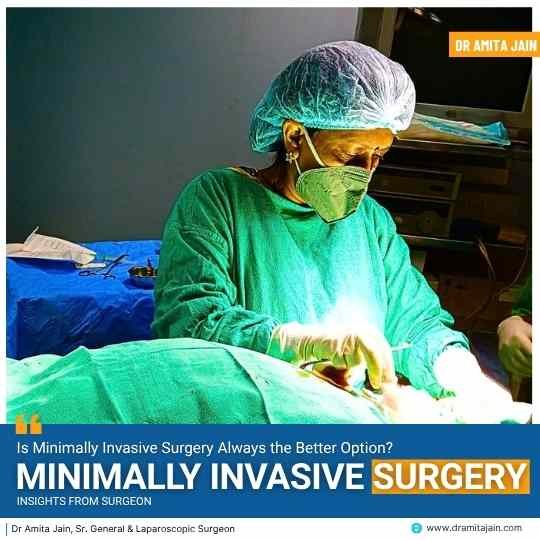
Medical technology has changed significantly over the years, giving surgeons access to advanced techniques that can reduce the size of surgical incisions and support faster recovery. Minimally invasive surgery has become increasingly popular because it often involves less tissue damage, reduced pain and shorter hospital stays.
However, minimally invasive surgery is not automatically the best choice for every patient or every condition. The right surgical approach depends on the type of illness, the complexity of the procedure, the patient’s overall health and the surgeon’s experience. In some cases, traditional open surgery may provide better access and safer treatment, shares Dr Amita Jain, Senior General and Laparoscopic Surgeon, a Specialist for minimally invasive treatment in Delhi and India.
What Is Minimally Invasive Surgery?
Minimally invasive surgery involves performing an operation through small incisions or natural body openings. Surgeons may use specialised instruments, cameras and advanced equipment to view and treat the affected area. Common examples include laparoscopic surgery, arthroscopy and certain robotic-assisted procedures.
Minimally invasive surgery involves performing an operation through small incisions or natural body openings. Surgeons may use specialised instruments, cameras and advanced equipment to view and treat the affected area. Common examples include laparoscopic surgery, arthroscopy and certain robotic-assisted procedures.
“The best surgery is not always the one with the smallest incision, but the one that offers the safest and most effective outcome.” Says Dr Amita Jain, Senior General Surgeon, MBBS, MS (General Surgery), Fellowship (AIIMS) in Laparoscopy, Proctologist, Ex-Professor Surgery, 30+ Years of Surgical Experience
What Are the Benefits of Minimally Invasive Surgery?
Minimally invasive techniques can offer several advantages when they are suitable for the patient.
- Smaller Incisions – These procedures generally require smaller cuts than traditional open surgery. This may result in less visible scarring and reduced damage to surrounding tissues.
- Reduced Postoperative Discomfort – Because the surgical access is often smaller, some patients experience less pain after the procedure. However, the level of discomfort depends on the operation, the body area involved and individual pain tolerance.
- Faster Recovery – Many minimally invasive procedures allow patients to return to normal activities sooner than they might after open surgery. Recovery time still varies depending on the complexity of the procedure and the patient’s overall condition.
- Shorter Hospital Stay – Certain minimally invasive operations may allow patients to leave the hospital earlier. Some procedures can even be performed as day-care surgeries when medically appropriate.
- Lower Risk of Certain Complications – In selected cases, minimally invasive surgery may reduce the risk of wound-related problems, excessive blood loss or infection. These benefits are not guaranteed and depend on the procedure and the patient.
Why Is Minimally Invasive Surgery Not Always the Best Choice?
Despite its advantages, minimally invasive surgery has limitations. The technique may not be suitable when the condition is complex, the affected area is difficult to access or the patient requires extensive surgical treatment.
In some situations, an open procedure may give the surgeon better visibility, control and access. Choosing a smaller incision should never be more important than completing the surgery safely and effectively.
- The Importance of the Surgical Condition
The nature of the medical condition plays a major role in deciding the surgical approach. For example, a straightforward procedure may be well suited to minimally invasive treatment. However, complicated disease, extensive damage, unusual anatomy or severe infection may require a more traditional approach. The surgeon must consider whether the minimally invasive technique can achieve the same treatment goal as open surgery.
- Patient Health and Medical History
A patient’s general health can also influence the decision. Previous surgeries, existing medical conditions, medication use, body structure and anaesthesia-related risks may affect whether minimally invasive surgery is appropriate.
Patients with certain heart or lung conditions may require additional assessment before undergoing procedures that involve specialised positioning or gas insufflation. A detailed medical evaluation helps the surgical team identify the safest option.
- The Surgeon’s Experience Matters
The success of minimally invasive surgery depends not only on the equipment but also on the surgeon’s training and experience. A surgeon who regularly performs a particular minimally invasive procedure may be better equipped to manage its technical challenges and possible complications. The availability of experienced support staff and suitable hospital facilities is also important. Patients should feel comfortable asking their surgeon about experience, expected outcomes, possible risks and alternative approaches.
When Open Surgery May Be More Appropriate
Open surgery may be recommended when:
- The condition requires wide access to the affected area.
- There is extensive tissue damage or infection.
- The anatomy is difficult to approach through small incisions.
- A large mass or complicated disease needs to be treated.
- The surgeon needs better control over bleeding or surrounding structures.
- A minimally invasive procedure would not provide the required result.
Open surgery is not necessarily an outdated option. In many cases, it remains the most reliable and appropriate method of treatment.
The Possibility of Changing the Surgical Approach
Sometimes a procedure that begins as minimally invasive may need to be converted into open surgery. This can happen if the surgeon encounters unexpected bleeding, unclear anatomy, technical difficulties or a condition that requires wider access.
Conversion is not automatically a failure. It may be a safety decision made to protect the patient and achieve the best possible outcome. Patients should understand that the surgical plan may change during the operation if circumstances require it.
Making an Informed Surgical Decision
Before choosing a procedure, patients should discuss several important points with their surgeon:
- What is the goal of the surgery?
- Is minimally invasive surgery suitable for the condition?
- What are the possible benefits and risks?
- Would open surgery offer a better result?
- What is the expected recovery period?
- Could the surgical approach change during the operation?
- What happens if complications occur?
Understanding these factors allows patients to make informed decisions rather than choosing a procedure only because it involves smaller incisions.
Safety Should Always Come First
The most important goal of surgery is to treat the medical problem safely and effectively. A minimally invasive approach may offer faster recovery and less discomfort, but it is not always the right option.
The best surgical method is the one that provides the greatest benefit while keeping the patient’s safety, condition and long-term outcome in mind. In some cases, that may be minimally invasive surgery. In others, traditional open surgery may be the better choice.
The Right Surgery for the Right Patient
Minimally invasive surgery has transformed modern treatment and offers significant benefits for many patients. However, it should not be considered automatically superior in every situation.
The final decision should be based on the patient’s medical condition, individual risk factors, available technology and the surgeon’s expertise. A personalised discussion with a qualified surgeon can help determine which approach is most suitable. The best surgery is not always the one with the smallest incision—it is the one that offers the safest and most effective outcome for the patient.

Dr Amita Jain is one of India’s most distinguished and experienced female surgeons and proctologists, known for her unmatched expertise in general, advanced laparoscopic, and laser proctology surgery. With over 30 years of surgical excellence, Dr Amita Jain has built a reputation for precision, compassionate care, and advanced surgical techniques.
Dr Jain has successfully performed a wide range of complex general surgeries, including both open and minimally invasive procedures, with a strong focus on trauma care, onco-surgical techniques, and reconstructive surgeries. Her medical specialisation includes: gallbladder surgeries, appendix removal surgeries, hernia repair surgeries, Pilonidal Sinus treatments, varicose vein and piles surgeries, fistula surgeries and fissure surgeries.
Dr Jain, currently serves as Senior Consultant and Head of Department (General, Laser, Proctology and Laparoscopic Surgeries) across premier medical networks in South Delhi:
Daffodils by Artemis Hospitals: Spring Meadows, East of Kailash, New Delhi. Book Appointment
Fortis C-DOC Hospital: B-16, Chirag Enclave, New Delhi. Book Appointment
Rosewalk Luxury Multi-Specialty & Maternity Hospital: Panchsheel Park, New Delhi. Book Appointment
Rainbow Children’s Hospital: Malviya Nagar, New Delhi. Book Appointment
Learn More about Dr Amita Jain.
Dr Amita Jain has also authored some of the key medical journals and publications, like ResearchGate, IJSR
Note: This article is written and reviewed by Dr Amita Jain, while referring to her medical journals and publications.