Summary
- Most gallbladder polyps are benign and discovered incidentally, but size and growth pattern determine risk.
- Symptoms are often absent; diagnosis relies mainly on ultrasound and supportive imaging when required.
- Small polyps are monitored, while larger or suspicious ones are treated with laparoscopic gallbladder removal.
Article Medically Reviewed by Dr Amita Jain, MBBS, MS (Gen Surgery), Fellowship (AIIMS), Military-Precision Gallbladder Polyp Surgeon: 29 Years of Surgical Excellence by Ex-Indian Army Surgeon
Gallbladder polyps are often silent, yet they require expert evaluation to rule out malignancy. Discover the critical symptoms to watch for, when surgery becomes necessary, and why Dr. Amita Jain is a leading choice for gallbladder care and laparoscopic surgery in Delhi.
Gallbladder problems are often associated with stones, but not every abnormality inside the gallbladder is a stone. One lesser-known condition is a gallbladder polyp — a small growth that develops on the inner lining of the gallbladder. Most polyps are harmless and discovered incidentally during an ultrasound done for abdominal pain or digestive discomfort. However, some types may require careful monitoring or treatment, especially if they grow in size or show suspicious features.
Understanding what a gallbladder polyp is, how it presents, and when treatment is necessary helps patients avoid unnecessary fear while ensuring timely care, says Dr Amita Jain, an experienced senior general and laparoscopic surgeon and specialist in treating gallbladder polyps in Delhi.
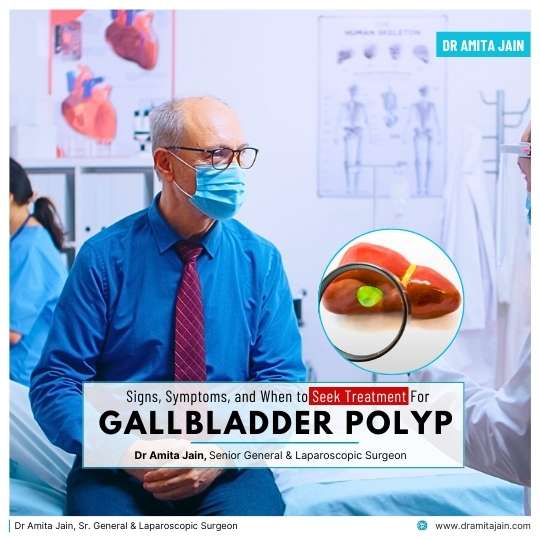
Are Gallbladder Polyps Dangerous?
A gallbladder polyp is a projection of tissue that grows from the gallbladder wall into its inner space. These growths can be single or multiple and vary in size. In most cases, they are benign (non-cancerous), particularly when they are small.
Dr Amita Jain states that, “A condition that stays silent doesn’t have to become serious—regular monitoring and timely decisions keep gallbladder polyps safe, controlled, and confidently managed. An early detection, careful observation, and the right treatment at the right time transform gallbladder polyps from a worrying discovery into a manageable medical condition.”
Doctors generally classify gallbladder polyps into two broad types:
- Non-cancerous (benign) polyps – These are the most common and usually do not pose serious health risks. Cholesterol polyps, which form due to fat deposits in the gallbladder lining, fall into this category. Inflammatory polyps that develop because of chronic irritation are also typically harmless.
- Potentially cancerous polyps – Larger polyps or those with certain structural features may carry a risk of malignancy. While gallbladder cancer is rare, early identification of suspicious polyps is important because the disease can be aggressive if detected late.
Size plays a major role in risk assessment. Polyps smaller than 5 mm are usually considered low risk. Those between 6–9 mm are monitored regularly. Polyps 10 mm or larger often require surgical removal of the gallbladder as a precaution.
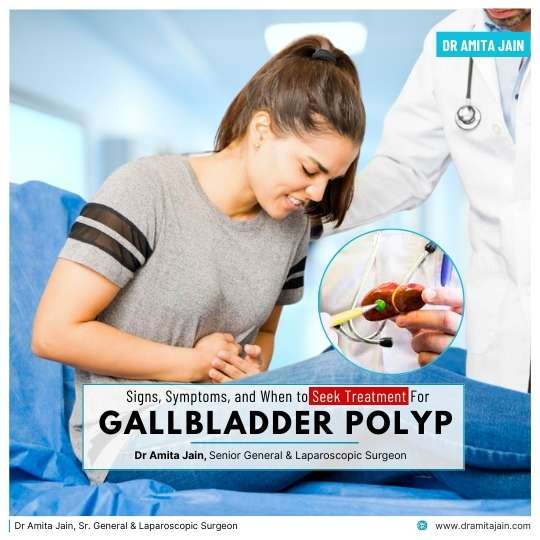
Symptoms of Gallbladder Polyps
Most gallbladder polyps do not cause symptoms. They are commonly found during imaging tests performed for unrelated reasons. When symptoms occur, they may resemble other gallbladder disorders:
- Dull or sharp pain in the upper right abdomen
- Nausea or vomiting
- Indigestion and bloating after fatty meals
- Occasional discomfort that mimics gallstone pain
Because these symptoms are nonspecific, imaging tests are essential for diagnosis.
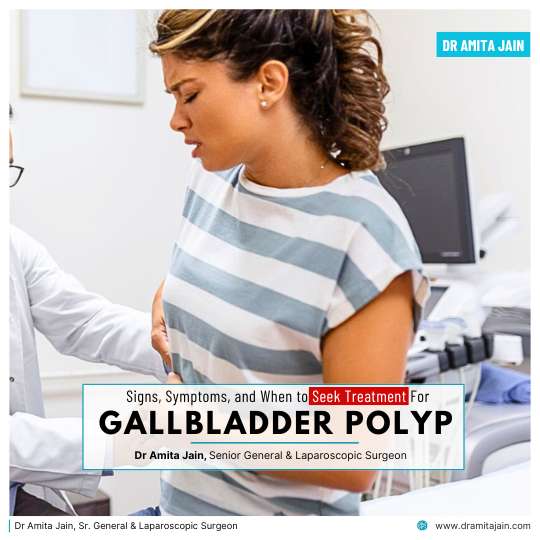
How Are Gallbladder Polyps Diagnosed?
The most common diagnostic tool is an abdominal ultrasound. It is non-invasive, widely available, and effective in detecting polyps and measuring their size.
If more detail is needed, doctors may advise advanced imaging such as CT scans or MRI to evaluate the structure and rule out malignancy. In some cases, endoscopic ultrasound provides highly detailed images for better assessment.
Treatment Options – Treatment depends mainly on the size of the polyp, associated symptoms, and patient risk factors.
Observation and monitoring – Small, asymptomatic polyps are usually monitored through periodic ultrasounds. Many remain stable for years without causing harm.
Surgical removal (Cholecystectomy) – Surgery to remove the gallbladder is recommended when:
- The polyp is 10 mm or larger
- There is rapid growth over time
- Symptoms persist
- The patient has additional risk factors, such as age or gallstones
Gallbladder removal is commonly performed using minimally invasive laparoscopic techniques, allowing faster recovery and less postoperative discomfort.
Living Without a Gallbladder
The gallbladder stores bile, but it is not essential for survival. After removal, bile flows directly from the liver to the intestine. Most patients return to normal digestion within a few weeks, though some may need temporary dietary adjustments.
Quick Reference Table
| Aspect | Details |
|---|---|
| What it is | A tissue growth arising from the inner wall of the gallbladder |
| Common nature | Usually benign, especially when small |
| Typical symptoms | Often none; may include upper right abdominal pain, nausea, bloating |
| Main diagnosis tool | Abdominal ultrasound |
| Low-risk size | Less than 5 mm — usually observation only |
| Intermediate size | 6–9 mm — regular follow-up imaging |
| Higher-risk size | 10 mm or more — surgery often advised |
| Standard treatment | Laparoscopic cholecystectomy when indicated |
| Life after surgery | Normal digestion resumes; minor temporary diet changes may help |
Gallbladder polyps are usually harmless but should never be ignored. Regular monitoring ensures early detection of potentially risky changes, while timely surgery prevents complications when needed. With modern diagnostic tools and minimally invasive treatments, managing this condition is both safe and effective.

Dr Amita Jain is one of India’s most distinguished and experienced female surgeons and proctologists, known for her unmatched expertise in general, advanced laparoscopic, and laser proctology surgery. With over 30 years of surgical excellence, Dr Amita Jain has built a reputation for precision, compassionate care, and advanced surgical techniques.
Dr Jain has successfully performed a wide range of complex general surgeries, including both open and minimally invasive procedures, with a strong focus on trauma care, onco-surgical techniques, and reconstructive surgeries. Her medical specialisation includes: gallbladder surgeries, appendix removal surgeries, hernia repair surgeries, Pilonidal Sinus treatments, varicose vein and piles surgeries, fistula surgeries and fissure surgeries.
Dr Jain, currently serves as Senior Consultant and Head of Department (General, Laser, Proctology and Laparoscopic Surgeries) across premier medical networks in South Delhi:
Daffodils by Artemis Hospitals: Spring Meadows, East of Kailash, New Delhi. Book Appointment
Fortis C-DOC Hospital: B-16, Chirag Enclave, New Delhi. Book Appointment
Rosewalk Luxury Multi-Specialty & Maternity Hospital: Panchsheel Park, New Delhi. Book Appointment
Rainbow Children’s Hospital: Malviya Nagar, New Delhi. Book Appointment
Learn More about Dr Amita Jain.
Dr Amita Jain has also authored some of the key medical journals and publications, like ResearchGate, IJSR
Note: This article is written and reviewed by Dr Amita Jain, while referring to her medical journals and publications.