Urgent Checklist: Is it Appendicitis?
- Primary Sign: Pain that started near the belly button and moved to the lower right side.
- Urgency: If the pain is sharp and accompanied by fever, seek medical attention within 24 hours.
- Avoid: Do not use laxatives or heating pads, as these can cause an inflamed appendix to rupture.
"In my 29 years of practice, I’ve seen that the hardest part for a patient isn't the surgery—it’s the uncertainty. Many people wait too long because they don't want to 'overreact' to what feels like a simple stomach ache. I tell my patients: your intuition matters. If the pain feels 'different' or 'wrong,' it usually is. My goal is to give you the clarity to act before a minor inflammation becomes a major crisis." - Dr Amita Jain

"Acute appendicitis is a condition where timing directly influences outcome. In surgical practice, the goal is not just removal of the appendix, but preventing the stage where complications begin. Early intervention keeps treatment straightforward and recovery controlled."- Dr Amita Jain
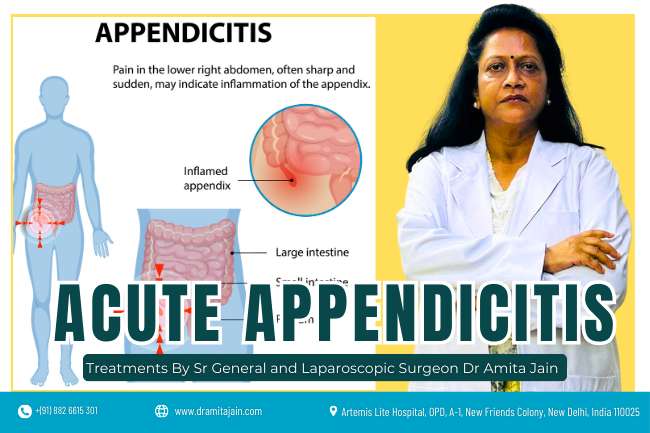
Acute appendicitis is an emergency abdominal condition caused by sudden inflammation of the appendix, usually due to internal blockage. Unlike conditions that can be monitored over time, appendicitis tends to worsen within hours. If not treated at the right stage, it may lead to rupture, infection spread, and more complex surgical situations.
What Makes Acute Appendicitis Clinically Significant?
Appendicitis vs. Similar Conditions
- Acute Appendicitis Vs. Kidney Stones: Kidney stone pain usually comes in intense waves and travels toward the groin; appendicitis pain is typically constant and stays in the abdomen.
- Acute Appendicitis Vs. Food Poisoning: Food poisoning usually starts with vomiting before pain; in appendicitis, the pain almost always comes before the vomiting.
- Pain that shifts location rather than staying generalized
- Increasing intensity rather than fluctuating discomfort
- Body responding with systemic signs like fever and nausea
- Localized guarding indicating deeper inflammation
This evolving pattern is what differentiates appendicitis from routine digestive disturbances. Dr Amita Jain notes, “The body gives warning signals—but they intensify, not settle. Recognizing this change early is what prevents complications.”

Acute Appendicitis Treatment Pathways: Procedural Overview
"Leveraging my background as an Indian Army surgeon, I follow a 'Triple-Check' sterilization and irrigation protocol. This goes beyond simple removal; we perform a deep-cleanse of the abdominal cavity to ensure no micro-infections remain, which drastically reduces the risk of post-operative abscesses—a common reason for re-hospitalization in standard care." - Dr Amita Jain
Appendectomy Approaches
Appendectomy Approaches – Clinical Comparison
| Approach |
Clinical Situation |
Typical Recovery |
| Laparoscopic Appendectomy |
Early to moderate inflammation |
1–3 Days |
| Open Appendectomy |
Perforation / advanced infection |
4–7 Days |
How is the Treatment Strategy Decided?
Management is not about symptom control—it is about eliminating the source of inflammation before it escalates.
Initial Medical Assessment Before proceeding to surgery, a structured evaluation is carried out:
- Clinical examination focusing on pain localization
- Blood investigations to detect infection markers.
- Imaging (ultrasound or CT scan) for confirmation.
- Monitoring progression over a short observation window if needed.
This stage is about diagnostic clarity, not prolonged delay.
Why Conservative Treatment Has Limited Role?
Unlike some abdominal conditions, appendicitis does not reliably resolve on its own. Medication may temporarily reduce inflammation in select cases, but it does not remove the underlying obstruction.
In real-world surgical decision-making, delaying definitive treatment increases:
That’s why treatment is directed toward resolution, not temporary relief.
Surgical Management – Focus on Controlled Resolution
The Triple-Check Protocol: An Army Surgeon’s Approach
- 1. Visual Margin Check: A 360-degree inspection of the appendix base to ensure the inflammation hasn't affected surrounding tissues.
- 2. Systemic Cavity Irrigation: A thorough "deep-cleanse" of the abdominal area with sterile saline to remove microscopic bacteria, drastically reducing the risk of post-operative abscesses.
- 3. Hemostatic Integrity Check: A final verification of the surgical site and vascular seals to ensure perfect closure before finishing the procedure.
Structured Recovery Approach: The First 48 Hours
"In surgical recovery, the first 48 hours set the tone. A disciplined approach during this period reduces complications and supports faster return to routine activity."
Stepwise Care Framework
Recovery and Post-Treatment Stability
Recovery depends more on timing than complexity of surgery. Patients are generally advised:
- Gradual reintroduction of diet
- Maintaining hydration
- Avoiding physical strain temporarily
- Monitoring surgical site healing
- Reporting any fever or unusual symptoms early
Why Patients Choose Dr Amita Jain?
"My background in the Indian Army instilled a 'zero-error' mentality in me, which is why I use the Triple-Check protocol. But beyond the technical precision, I believe in personalized care. I don’t believe in 'factory-style' surgery. I personally oversee your journey from the first consultation to the final check-up, ensuring the discipline of the procedure is matched by the warmth of the care." - Dr Amita Jain
- 29+ years of surgical experience
- Background as an Indian Army surgeon with precision-driven protocols in handling both routine and emergency abdominal cases
- Balanced judgment between urgency and safety
- Clear, structured patient guidance
- Focus on outcome stability, not just immediate relief
Book your appointment for consultation with Dr Amita Jain.
Dr. Amita Jain offers patients the flexibility of specialized surgical care at several premium healthcare facilities across South Delhi. Depending on their specific needs and convenience, patients can choose to be operated on at prestigious locations, including:
- Fortis C-Doc Hospital : OPD, B-16, Nehru Place Flyover, opp. Devika Tower, Chirag Enclave, Greater Kailash, New Delhi, Delhi 110048
- Rosewalk Luxury Maternity Hospital : OPD, N-88, Block N, Panchsheel Park North, Panchsheel Park, New Delhi, Delhi 110017.
- Madhukar Rainbow Children's Hospital : OPD, FC-29 5, Geetanjali Marg, near Malviya Nagar, Block A, Shivalik Colony, Malviya Nagar, New Delhi, Delhi 110017
Consult Dr Amita Jain
FAQ for Acute Appendicitis Treatment
What Are the Early Signs of Acute Appendicitis?
As explained by Dr Amita Jain, acute appendicitis begins with subtle abdominal symptoms that rapidly worsen over time.
- Pain Near Navel: Starts centrally and shifts right side.
- Loss of Appetite: Sudden reduction in hunger.
- Nausea or Vomiting: Common early symptom.
- Mild Fever: Indicates infection onset.
- Pain on Movement: Worsens with activity.
Can Acute Appendicitis Be Treated Without Surgery?
As explained by Dr Amita Jain, surgery is usually required, though early cases may sometimes be managed temporarily.
- Appendectomy Required: Definitive treatment.
- Antibiotics: Used in early stages.
- Pain Relief: Symptom control.
- Monitoring: Prevents complications.
- Emergency Care: Needed if worsening.
How Quickly Does Acute Appendicitis Progress?
As explained by Dr Amita Jain, appendicitis can worsen rapidly within hours.
- Rapid Pain Increase: Symptoms escalate quickly.
- Fever Development: Infection spreads.
- Pain Migration: Moves to right abdomen.
- Tender Abdomen: Becomes sensitive.
- Emergency Risk: Delay increases danger.
What Complications Can Occur in Acute Appendicitis?
As explained by Dr Amita Jain, untreated appendicitis can lead to serious complications.
- Appendix Rupture: Leads to infection spread.
- Peritonitis: Abdominal lining infection.
- Abscess Formation: Pus collection.
- Sepsis Risk: Blood infection.
- Emergency Surgery: Required urgently.
When Should Someone Seek Immediate Care?
As explained by Dr Amita Jain, early medical attention prevents severe outcomes.
- Severe Right Pain: Persistent and worsening.
- Fever with Pain: Infection sign.
- Vomiting: Continuous symptoms.
- Abdominal Stiffness: Increasing tenderness.
- No Improvement: Symptoms persist.