Urgent Checklist: Could It Be an Appendiceal Abscess?
- Delayed Pattern: Pain that began like appendicitis but has persisted for several days and become more localized.
- Fever Trend: Ongoing or spiking fever with chills rather than mild temperature.
- Palpable Concern: A feeling of heaviness or a tender lump in the lower right abdomen.
- General Condition: Weakness, reduced appetite, and signs of infection building up.
Important: Self-medication or ignoring prolonged symptoms can allow infection to collect and form an abscess, making treatment more complex.
“An appendiceal abscess is not just inflammation—it’s the body’s way of containing infection. Patients often feel temporary relief thinking the problem is settling, but internally the condition is evolving into something that requires structured medical intervention.” - Dr Amita Jain
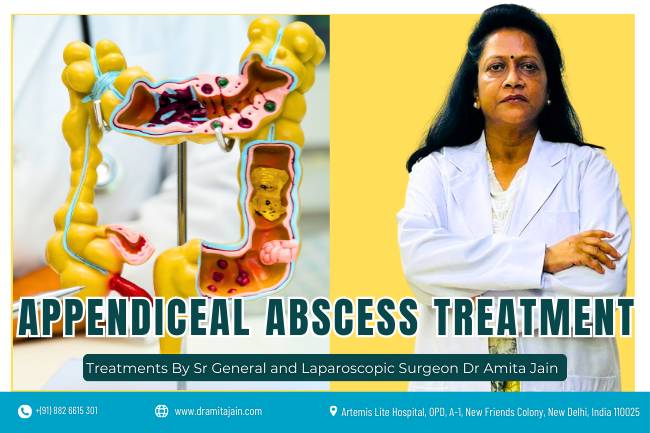
Understanding Appendiceal Abscess
An appendiceal abscess develops when an inflamed appendix is not treated in time and the infection becomes walled off by surrounding tissues. Instead of spreading immediately, the body attempts to localize it, forming a pocket of pus.
This stage is clinically different from early appendicitis. While it may appear less dramatic initially, it requires careful handling because direct surgery at the wrong time can increase complications.
What many of our patients tell us:
"I thought it was just a bad stomach bug that wouldn't go away. I felt a little better after two days, but the fever wouldn't break, and the dull ache in my right side became a heavy, constant lump. I was scared to have surgery while feeling so weak."
Dr Amita Jain’s Note: This 'false recovery' is common. Your body is trying to wall off the infection. We focus on stabilizing you first so that when we do operate, your body is ready and the risk is at its lowest.
Is It Appendicitis, Appendiceal Abscess, or Just a Common Stomach Issue?
| Symptom / Condition |
Appendicitis |
Appendiceal Abscess |
Gas / Acidity |
Food Poisoning |
Kidney Stones |
| Pain Onset |
Sudden, builds within hours |
Develops slowly over days |
Sudden but short-lived |
Often starts after eating |
Sudden, intense waves |
| Pain Location |
Starts near navel → shifts right lower abdomen |
Localized right lower abdomen, may feel like a lump |
Upper abdomen or generalized |
Diffuse abdominal cramps |
Starts in back → moves to groin |
| Pain Nature |
Constant, worsening |
Persistent, deep, heavy |
Crampy, relieved after gas |
Cramping with discomfort |
Sharp, wave-like (comes and goes) |
| Fever |
Mild |
Moderate to high |
Rare |
Common |
Rare |
| Vomiting Pattern |
After pain starts |
May persist with infection |
Sometimes, but mild |
Usually starts early |
Due to severe pain |
| Appetite |
Loss of appetite |
Marked loss of appetite |
Usually normal |
Reduced |
Normal |
| Relief Pattern |
No relief with rest or medication |
Temporary dulling but not relief |
Relief after passing gas or antacids |
Symptoms fluctuate |
Pain comes in cycles |
| Other Signs |
Tenderness, guarding |
Possible abdominal lump, weakness |
Bloating, burping |
Diarrhea common |
Burning urination, restlessness |
Why Appendiceal Abscess Requires a Different Strategy?
Not a Typical Emergency — But Not Safe to Ignore
Unlike acute appendicitis where immediate surgery is often the first step, an abscess changes the approach. Operating too early without controlling infection may lead to:
Differentiating from Similar Conditions
Dr Amita Jain explains, “The key difference is progression. In an abscess, the body contains infection temporarily—but without treatment, that containment fails.”
Treatment Pathways: Stepwise and Controlled
Stage 1: Stabilization Before Intervention
The first priority is controlling infection, not rushing into surgery. This involves:
Stage 2: Abscess Drainage (If Required)
When the collection is significant, a minimally invasive drainage procedure is performed:
Stage 3: Interval Appendectomy (Planned Surgery)
Once inflammation subsides, the appendix is removed in a controlled setting:
Surgical Precision: Controlled Over Reactive
Drawing from disciplined surgical training, Dr Amita Jain follows a structured intra-operative protocol designed for infected cases:

Recovery and Long-Term Outcome
Recovery depends on timing and how well the infection was controlled before surgery. With a structured approach:
Why Patients Choose Dr Amita Jain?
Book Your Appointment With Dr Amita Jain
Dr. Amita Jain offers patients the flexibility of specialized surgical care at several premium healthcare facilities across South Delhi. Depending on their specific needs and convenience, patients can choose to be operated on at prestigious locations, including:
- Fortis C-Doc Hospital : OPD, B-16, Nehru Place Flyover, opp. Devika Tower, Chirag Enclave, Greater Kailash, New Delhi, Delhi 110048
- Rosewalk Luxury Maternity Hospital : OPD, N-88, Block N, Panchsheel Park North, Panchsheel Park, New Delhi, Delhi 110017.
- Madhukar Rainbow Children's Hospital : OPD, FC-29 5, Geetanjali Marg, near Malviya Nagar, Block A, Shivalik Colony, Malviya Nagar, New Delhi, Delhi 110017
Consult Dr Amita Jain
FAQ for Appendiceal Abscess Treatments and Surgeries
What Is an Appendiceal Abscess?
As explained by Dr Amita Jain, appendiceal abscess is a localized pus collection caused by untreated appendicitis.
- Pus Formation: Infection gets trapped.
- Abdominal Lump: Local swelling.
- Fever: Persistent infection.
- Pain: Continuous discomfort.
- Delayed Complication: After appendicitis.
How Is Appendiceal Abscess Treated?
As explained by Dr Amita Jain, treatment focuses on infection control first.
- Antibiotics: Reduce infection
- Drainage: Removes pus.
- Delayed Surgery: Done later if needed.
- Monitoring: Hospital care.
- Fluids: Support recovery.
What Are the Symptoms of Appendiceal Abscess?
As explained by Dr Amita Jain, symptoms are persistent and worsening.
- Fever: Ongoing infection.
- Local Pain: Right abdomen.
- Swelling: Tender mass.
- Fatigue: Weakness.
- Appetite Loss: Digestive issues.
Can Appendiceal Abscess Heal Without Surgery?
As explained by Dr Amita Jain, mild cases may respond to antibiotics and drainage without immediate surgery.
- Antibiotics:Technique chosen based on age and health status.
- Drainage: Removes pus.
- Observation: Hospital monitoring.
- Delayed Surgery: If needed later.
- Stabilization: First priority.
What Happens If It Is Not Treated?
As explained by Dr Amita Jain, untreated abscess can worsen significantly.
- Infection Spread: To abdomen.
- Sepsis Risk: Blood infection.
- Increased Pain: Worsening symptoms.
- Enlargement: Abscess grows.
- Emergency Care: Becomes critical.