We often wonder if surgery is always the only path to healing or improvement. After all, who wouldn’t wish to be cured without going under the knife? When it comes to gallstones, many people try to find natural ways to dissolve them. But the truth is, sometimes surgery simply cannot be avoided.
Gallbladder stones, or gallstones, are solid deposits of cholesterol or bilirubin that form in the gallbladder, a small organ beneath the liver. They can range from tiny grains to golf ball–sized stones. While some gallstones may pass spontaneously through the bile duct and exit the body unnoticed, many can get stuck, leading to serious complications like inflammation of the gallbladder (cholecystitis), pancreas (pancreatitis), or bile ducts (cholangitis), often requiring medical intervention.
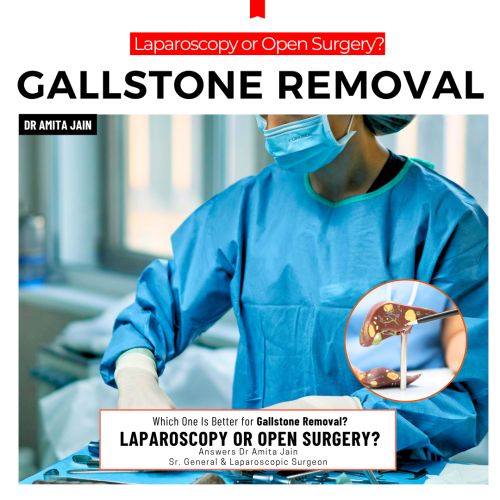
In some cases, medication can help dissolve gallstones, but these treatments take a long time, are not always effective, and the stones may return. That’s why doctors often recommend surgery, especially if the gallstones are large, painful, or cause complications like inflammation or jaundice.
When surgery becomes necessary, the next question is—which option should you choose: open or laparoscopic surgery? Dr Amita Jain, Senior General and Laparoscopic Surgeon and one of the most experienced gallbladder stone removal surgeons in Delhi and India, explains the key differences between the two procedures, helping patients understand their options and make an informed, confident decision about gallstone removal. So, how do you know when you need gallbladder surgery to remove gallstones?
You may need a cholecystectomy if gallstones cause pain or complications such as:
- Painful gallstones in the gallbladder (cholelithiasis)
- Stones blocking the bile duct (choledocholithiasis)
- Gallbladder inflammation (cholecystitis)
- Large or suspicious gallbladder polyps
- Pancreatitis caused by gallstones
- Concern for gallbladder cancer
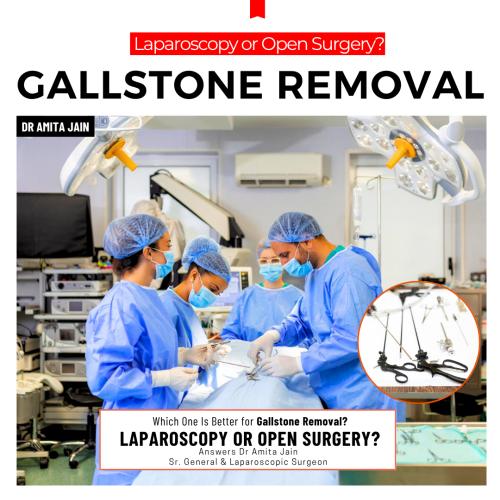
What is Open Gallbladder Surgery?
An open cholecystectomy is the traditional way of removing the gallbladder. Instead of using small keyhole cuts like in laparoscopic surgery, this method involves a single, larger incision in the upper right side of the abdomen.
This allows the surgeon to see and reach the gallbladder directly, giving a wide and clear view of the area.
Although the basic steps are similar to laparoscopic surgery, the main difference lies in how the surgeon accesses the gallbladder — through one larger opening rather than several small ones.
Pros of open gallbladder surgery
- Better visibility and control: The larger incision gives the surgeon a clearer view of the gallbladder and nearby organs. This can be especially helpful when anatomy is unclear or complications arise.
- Useful in complex cases: It’s often preferred when:
- There’s a serious infection or inflammation.
- The patient has had previous abdominal surgeries, leading to scar tissue that makes laparoscopic surgery difficult.
- Easier to manage unexpected issues: In case of bleeding, injury, or other problems, the surgeon has more room to operate and handle the situation safely.
- No need for special equipment: Unlike laparoscopic surgery, open cholecystectomy doesn’t rely on advanced cameras or instruments, making it more accessible in places where such tools are not available.
- Reliable technique: Surgeons have been performing open cholecystectomy for decades, so it’s a tried and tested method. Many patients feel reassured knowing their surgeon is highly skilled in this traditional approach.
Cons of open gallbladder surgery
- More pain post-surgery: Because the incision is larger, there’s more tissue damage, which can lead to greater discomfort during recovery.
- Longer recovery time: Healing usually takes longer than with laparoscopic surgery. Patients often stay in the hospital for a few days and may need several weeks before returning to normal activities.
- Higher risk of infection: A larger wound means a higher chance of infection. Doctors usually prescribe antibiotics and recommend careful wound cleaning to prevent this.
- More noticeable pain and scarring: The bigger incision can cause more visible scarring and more noticeable pain, although this usually improves over time.
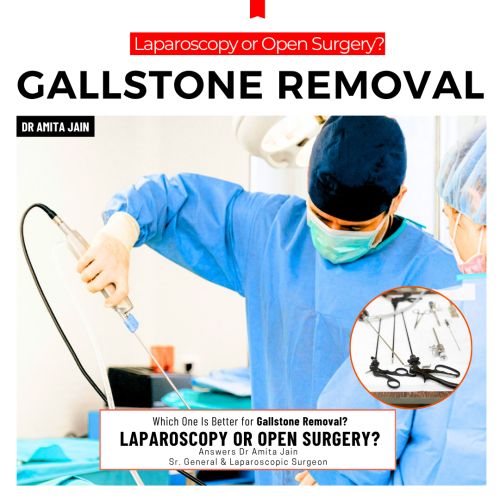
What is a Laparoscopic Gallbladder Surgery?
Laparoscopic cholecystectomy is a minimally invasive surgery to remove the gallbladder, usually done to treat gallstones. The surgeon makes a few small cuts in the abdomen and uses a camera and special tools to perform the procedure with video guidance.
Pros of Laparoscopic Gallbladder Surgery
- Small scars: Only tiny incisions, so minimal scarring.
- Quick recovery: Less pain, shorter hospital stay, and faster return to normal activities.
- Less pain: Usually milder discomfort compared to open surgery.
Cons of Laparoscopic Gallbladder Surgery
- Not for everyone: Severe inflammation or certain health issues may prevent its use.
- Limited view: The surgeon’s field of vision is narrower, though advanced tools help.
- Rare risks: Nearby organs like the bile duct may be accidentally injured.
- Gas pain: Temporary bloating from the gas used during surgery.
- Needs expertise: Requires trained surgeons and proper facilities.
Which One Would You Choose?
Well, whether to choose open or laparoscopic surgery for gallstone removal depends on several key factors:
Medical Condition: If your gallbladder disease is complicated or severe, open surgery might be a safer choice.
Recovery Time: Laparoscopic surgery usually allows for a quicker recovery and shorter hospital stay.
Cosmetic Concerns: Smaller incisions in laparoscopic surgery result in minimal scarring, which many find appealing.
Surgeon’s Recommendation: Your surgeon’s expertise and understanding of your specific case are crucial in deciding the best approach.
Finally, we have two main ways to remove gallstones: open surgery and laparoscopic surgery. Open surgery works well for complicated cases but involves a bigger cut, more pain, and longer recovery. Laparoscopic surgery has smaller cuts and quicker healing but isn’t suitable for everyone. The best choice depends on your health, recovery needs, and your surgeon’s advice. So don’t hesitate to consult your doctor—after all, your life matters most.

Dr Amita Jain, one of the most experienced General and Laparoscopic Surgeons in Delhi, is widely recognised for her expertise in hernia, piles, gallbladder, fissure, and fistula surgeries. With an outstanding career spanning over 29 years, Dr Amita Jain has earned her place among the top General and Laparoscopic surgeons in Delhi and India, known for her precision, compassion, and consistent surgical excellence. She was the Professor of Surgery at the Army College of Medical Sciences and Base Hospital, Delhi Cantt. In 1994, she was commissioned as a surgeon under the United Nations Mission in Congo.
Dr Amita Jain currently serves as the Head of Department, Laparoscopic and Trauma Surgery at Artemis Lite Hospital (Delhi), Senior General and Laparoscopic Surgeon at Rosewalk – Luxury Maternity Hospital in Delhi and Rainbow Children Hospitals (at Malviya Nagar and Panchsheel Park, New Delhi)
Dr Amita Jain has successfully performed a wide range of complex general surgeries, including both open and minimally invasive procedures, with a strong focus on trauma care, onco-surgical techniques, and reconstructive surgeries. Her medical specialisation includes – Gallbladder surgeries, appendix removal surgeries, hernia repair surgeries, Pilonidal Sinus treatments, varicose vein and piles surgeries, fistula surgeries and fissure surgeries.
Dr Amita Jain has also authored some of the key medical journals and publications, like ResearchGate, IJSR
Note: the articles are written with Dr Amita Jain’s professional insights and referring to her medical publications.