Article Medically Reviewed by Dr Amita Jain, MBBS, MS (Gen Surgery), Fellowship (AIIMS), Military-Precision Anorectal Care: 29 Years of Surgical Excellence by Ex-Indian Army Surgeon
Medical technology has rapidly evolved, allowing many conditions that once required major surgery to now be treated using minimally invasive techniques. In the field of colorectal and lower digestive tract disorders, energy-based procedures have gained popularity because they focus on precision, patient comfort, and faster healing.
Laser-based procedures are increasingly being chosen by patients seeking effective treatment with less discomfort and shorter downtime, especially when medications and lifestyle changes are not enough, says Dr Amita Jain, a Senior General and Laparoscopic Surgeon and one of the most experienced anorectal Surgeons in Delhi and India for painless laser piles surgeries, fissure surgeries and fistula treatments.

What Is Laser Surgery?
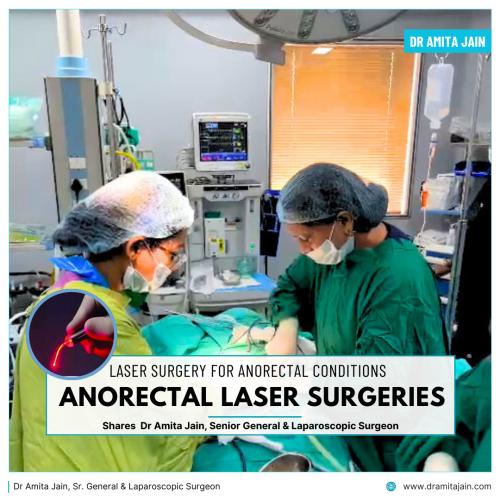
Laser surgery is a medical technique that uses a concentrated beam of light energy to treat diseased tissue. Instead of using traditional surgical instruments, this method delivers controlled heat energy directly to the targeted area.
The energy helps remove or shrink abnormal tissue while sealing tiny blood vessels at the same time. Because of this, there is usually less bleeding, less swelling, and reduced injury to surrounding healthy tissue. The precision of laser technology allows doctors to perform procedures with greater control, which often leads to a smoother recovery compared to conventional surgical methods.
How Laser Technology Is Used for Common Anorectal Conditions?
Treatment for Piles
Laser treatment can be used to shrink swollen vascular tissue by cutting off its blood supply. Over time, the affected tissue reduces in size and symptoms improve. Since the surrounding area is not widely cut open, patients usually experience less discomfort after the procedure. Many cases can be managed as short-stay or same-day procedures, allowing faster return to the daily routine.
Treatment for Fissures
In long-standing cases, laser energy can help remove scarred tissue and support natural healing. The controlled energy also helps reduce local muscle spasm in selected cases, which can contribute to better symptom relief. Patients often notice reduced pain during recovery compared to traditional surgical approaches.
Treatment for Fistula
Laser-assisted procedures can help close abnormal tracts from the inside using focused energy. One of the major advantages is the preservation of surrounding muscle function. This approach may reduce post-procedure discomfort and simplify wound care in suitable patients, though case selection remains very important.
Why Are Laser Procedures Considered a Modern Treatment Option?
Laser-based treatment matches current medical goals of preserving normal tissue while effectively treating disease. Because the procedure is highly targeted, it generally results in less trauma to the body. Many patients prefer this option because it can reduce hospital stay, allow quicker mobility, and help them return to work earlier.
Additionally, the risk of infection may be lower because the laser energy seals small vessels and tissue during treatment.
Who May Benefit From Laser-Based Treatment?
Laser procedures are often suitable for individuals with early to moderate disease who have not improved with medicines or lifestyle changes. They are also preferred by people who want minimal disruption to their daily life. However, more advanced or complicated diseases may still require conventional surgery depending on medical evaluation and imaging findings.
Recovery and Aftercare
Recovery after laser procedures is usually smoother, but proper care is still important. Patients are commonly advised to follow a fibre-rich diet, drink adequate fluids, and follow hygiene and bathing instructions given by their doctor. Light activities can usually be resumed within a few days, although full recovery time may vary depending on the condition treated.
Important Limitations to Understand
Laser treatment is not the right option for every patient. The success of the procedure depends on disease severity, overall health, and how well post-treatment care instructions are followed. A detailed medical examination is always required to decide the best treatment approach.
Laser surgery represents an important advancement in the treatment of lower digestive tract disorders. By offering precision treatment with less discomfort and faster healing, it has become an increasingly preferred choice for many patients. However, treatment decisions should always be based on individual medical assessment to ensure safe and long-term effective results.

Dr Amita Jain, one of the most experienced General and Laparoscopic Surgeons in Delhi, is widely recognised for her expertise in hernia, piles, gallbladder, fissure, and fistula surgeries. With an outstanding career spanning over 29 years, Dr Amita Jain has earned her place among the top General and Laparoscopic surgeons in Delhi and India, known for her precision, compassion, and consistent surgical excellence. She was the Professor of Surgery at the Army College of Medical Sciences and Base Hospital, Delhi Cantt. In 1994, she was commissioned as a surgeon under the United Nations Mission in Congo.
Dr Amita Jain currently serves as the Senior General and Laparoscopic Surgeon at Fortis C-DOC Hospital, Chirag Enclave, Greater Kailash, New Delhi. She is also the Head of Department, Laparoscopic and Trauma Surgery at Artemis Lite Hospital (Delhi), Senior General and Laparoscopic Surgeon at Rosewalk – Luxury Maternity Hospital in Delhi and Rainbow Children Hospitals (at Malviya Nagar and Panchsheel Park, New Delhi)
Dr Amita Jain has successfully performed a wide range of complex general surgeries, including both open and minimally invasive procedures, with a strong focus on trauma care, onco-surgical techniques, and reconstructive surgeries. Her medical specialisation includes – Gallbladder surgeries, appendix removal surgeries, hernia repair surgeries, Pilonidal Sinus treatments, varicose vein and piles surgeries, fistula surgeries and fissure surgeries.
Dr Amita Jain has also authored some of the key medical journals and publications, like ResearchGate, IJSR
Note: the articles are written with Dr Amita Jain’s professional insights and referring to her medical publications.