Summary
- A fissure and a fistula are different conditions with distinct causes, symptoms, and treatment approaches.
- A fissure does not directly turn into a fistula, but untreated infections can sometimes lead to fistula formation.
- Early diagnosis and timely treatment help prevent complications and ensure faster, more effective recovery.
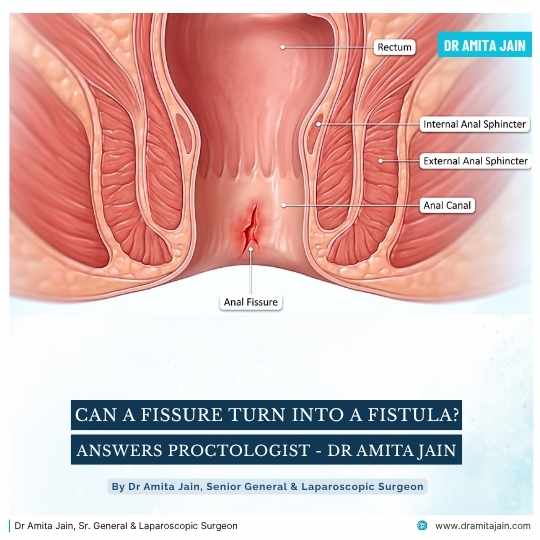
A fissure and a fistula are two common conditions that affect the area around the bowel opening. Since both can cause pain, discomfort, and difficulty during bowel movements, many people assume they are the same problem or believe that one eventually turns into the other. This often leads to unnecessary anxiety and delays in seeking the right treatment.
The truth is that a fissure and a fistula are different conditions with different causes. While a fissure does not directly become a fistula, certain complications, especially those involving infection, may increase the risk of developing one. Understanding how these conditions differ can help you recognise warning signs early and seek appropriate medical care. Dr Amita Jain, a Senior General and Laparoscopic Surgeon in Delhi and a proctologist for fistula and fissure, speaks on the topic in this blog.
What Is a Fissure?
A fissure is a small tear in the delicate skin around the bowel opening. It commonly develops after passing hard stools, chronic constipation, repeated diarrhoea, or excessive straining during bowel movements. Although anyone can develop a fissure, it is particularly common among people who frequently suffer from constipation.
Most fissures heal within a few weeks with conservative treatment. However, if they are left untreated or remain irritated, they may become chronic and cause ongoing discomfort.
What Is a Fistula?
A fistula is a small abnormal tunnel that forms beneath the skin around the bowel opening. It usually develops after an infection creates a collection of pus beneath the skin. Even after the infection drains, a passage may remain, resulting in a fistula. Unlike a fissure, a fistula rarely heals on its own and generally requires medical or surgical treatment.

Can a Fissure Turn Into a Fistula?
The simple answer is no. A fissure does not directly turn into a fistula because they develop in different ways.
A fissure is a tear in the skin, whereas a fistula usually develops because of an infection beneath the skin. These are separate conditions with different underlying causes.
However, if a chronic fissure becomes infected or if an untreated infection develops nearby, complications may occur. In rare situations, the infection can lead to the formation of a fistula. This does not mean the fissure itself changed into a fistula. Instead, an infection created a completely different condition.
“A fissure and a fistula may cause similar symptoms, but they are different conditions that require different treatments. Early diagnosis is the key to preventing complications.” Dr Amita Jain, Sr General and Laparoscopic Surgeon and an experienced Proctologist for laser piles, fissure and fistula surgery.
How Can You Tell the Difference Between a Fissure and a Fistula?
Although both conditions can cause pain, their symptoms are usually quite different. A fissure typically causes sharp pain during and after bowel movements. Many people also notice small amounts of fresh bleeding, especially on toilet paper. The discomfort often improves between bowel movements.
A fistula, on the other hand, is more likely to cause continuous discomfort, swelling, recurring boils, or persistent discharge. Some people may notice fluid or pus leaking from a small opening near the affected area. The symptoms often return repeatedly if the underlying problem is not treated. Because the symptoms can overlap, a proper medical examination is the best way to determine the exact condition.
What Causes a Fistula to Develop?
Most fistulas develop after an infection beneath the skin around the bowel opening. When this infection forms a pocket of pus and does not heal completely, a tunnel can develop between the infected area and the skin surface.
Certain medical conditions, such as Crohn’s disease, diabetes, weakened immunity, or repeated infections, may increase the likelihood of developing a fistula.
How Are These Conditions Diagnosed?
Diagnosis usually begins with a detailed discussion about your symptoms, followed by a careful physical examination by an experienced surgeon.
If a fistula is suspected, imaging tests such as an MRI may be recommended to identify the exact path of the tunnel. In some cases, additional examinations help determine the severity of the condition and guide the most appropriate treatment. An accurate diagnosis is important because the treatment for a fissure is very different from that for a fistula.
How Is a Fissure Treated?
Most fresh fissures respond well to non-surgical treatment. Increasing dietary fiber, drinking adequate water, avoiding constipation, and taking warm sitz baths can help the tear heal naturally.
Doctors may also prescribe medications that reduce muscle spasm and improve blood flow, allowing the affected area to heal more quickly. If the fissure becomes chronic or does not respond to conservative treatment, advanced procedures, including laser treatment or surgery, may be recommended.
How Is a Fistula Treated?
Unlike a fissure, a fistula usually does not heal without medical intervention. The abnormal tunnel generally needs to be removed or closed through an appropriate surgical procedure.
Depending on the complexity of the condition, treatment may involve laser surgery or other advanced surgical techniques designed to eliminate the fistula while preserving normal muscle function as much as possible. Early treatment helps reduce the risk of repeated infections and improves long-term outcomes.
When Should You Consult a Doctor?
Persistent pain during bowel movements, repeated bleeding, swelling, recurring boils, or discharge around the bowel opening should never be ignored. If these symptoms continue for more than a few days or keep returning, it is important to seek medical attention.
Delaying treatment can increase discomfort and may allow complications to develop, making treatment more complex.
A fissure does not directly turn into a fistula, but untreated infections around the bowel opening can sometimes lead to the development of a fistula. Since both conditions require different treatments, identifying the correct cause of your symptoms is essential.
If you have ongoing pain, bleeding, swelling, or discharge, do not rely solely on home remedies. Consulting an experienced surgeon like Dr Amita Jain can help you receive the right diagnosis and timely treatment, reducing the risk of complications and helping you return to your normal routine sooner.

Dr Amita Jain, one of the most experienced General and Laparoscopic Surgeons in Delhi, is widely recognised for her expertise in hernia, piles, gallbladder, fissure, and fistula surgeries. With an outstanding career spanning over 29 years, Dr Amita Jain has earned her place among the top General and Laparoscopic surgeons in Delhi and India, known for her precision, compassion, and consistent surgical excellence. She was the Professor of Surgery at the Army College of Medical Sciences and Base Hospital, Delhi Cantt. In 1994, she was commissioned as a surgeon under the United Nations Mission in Congo.
Dr Amita Jain currently serves as the Senior General and Laparoscopic Surgeon at Fortis C-DOC Hospital, B-16, Chirag Enclave, Opposite Devika Tower, Greater Kailash 1, New Delhi, Delhi 110048. She is also the Senior General and Laparoscopic Surgeon at Rosewalk – Luxury Multi-Speciality Hospital in Delhi and Rainbow Multi-Speciality Hospitals (at Malviya Nagar and Panchsheel Park, New Delhi)
Dr Amita Jain has successfully performed a wide range of complex general surgeries, including both open and minimally invasive procedures, with a strong focus on trauma care, onco-surgical techniques, and reconstructive surgeries. Her medical specialisation includes – Gallbladder surgeries, appendix removal surgeries, hernia repair surgeries, Pilonidal Sinus treatments, varicose vein and piles surgeries, fistula surgeries and fissure surgeries. Learn More about Dr Amita Jain.
Dr Amita Jain has also authored some of the key medical journals and publications, like ResearchGate, IJSR
Note: the articles are written with Dr Amita Jain’s professional insights and referring to her medical publications.