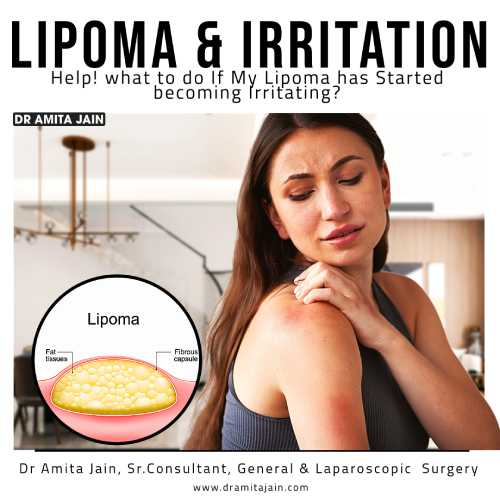
Everybody wants to stay healthy and fit, and finding a lump on your body can be worrisome. However, not all lumps are cancerous. One common non-cancerous lump is a lipoma, which is a round or oval-shaped mass of fatty tissue found just beneath the skin.
Lipomas are usually painless and can be easily moved when touched. They can appear anywhere on the body but are most common on the back, trunk, arms, shoulders, and neck. While lipomas typically occur between ages 40 and 60, they can develop at any age and may even be present at birth. Although lipomas affect people of all genders, they are slightly more common in women.
Dr Amita Jain, who is one the best laparoscopic surgeons in India and specialises in lipoma surgery, tells us what to do when lipomas become bothersome.
When do you need to consult a doctor?
You need to understand that although lipomas typically pose no immediate threat to your health, it’s essential to consult a doctor whenever you detect any unusual lumps, growths, knots, or changes in your skin.
Even though lipomas are non-cancerous, they exhibit symptoms similar to more serious conditions such as liposarcoma, a rare form of cancer.
Liposarcomas are malignant soft tissue tumors that can develop deep within the body’s soft tissues.
Unlike lipomas, which generally remain small (typically reaching no more than 2 inches across), liposarcomas have the potential to grow significantly larger, particularly in the retroperitoneum (the back half of the belly).
Seeking medical advice is essential to confirm whether a growth is a harmless lipoma or a potentially harmful liposarcoma.
This confirmation can be achieved through a thorough physical examination, biopsy, or imaging tests such as X-rays, CT scans, or MRIs.
So, if you find that a lipoma is causing you discomfort or if you’re uncertain about whether it’s a lipoma or a liposarcoma, it’s best to seek professional medical guidance without delay.
What about the Diagnosis?
Diagnosing lipomas typically begins with a thorough physical examination where the lump is inspected and palpated.
If the lipoma presents significant size or discomfort, further tests may be warranted to rule out malignancy.
Biopsy, involving the removal of a small tissue sample for microscopic analysis, is commonly employed to confirm diagnosis.
Additionally, imaging techniques such as X-rays, CT scans, and MRIs play a vital role in assessing the nature of the growth.
These studies not only aid in distinguishing lipomas from other lesions like cysts but also provide insights into their depth, vascularity, and potential compression of nearby structures like nerves or tissues.
What are the Treatment Options?
Lipomas can be treated surgically. These options are:
Excision: One method involves making a small incision in the skin under local anesthesia and then gently squeezing out the lipoma.
This outpatient procedure allows the individual to return home on the same day. For larger lipomas, a more substantial incision may be necessary to remove the growth entirely.
Liposuction: Some lipomas can be eliminated using liposuction. During this process, the doctor makes an incision, inserts a thin, hollow tube, and suction out the mass of fat cells.
Steroids are sometimes used to shrink the tumor.
Following surgery, the removed lipoma tissue is typically sent to a laboratory for analysis. Despite these interventions, the resulting scars are usually minimal once the wound has properly healed.
Lipomas rarely come back once removed, but new growths may develop in other parts of the body. Prompt consultation with a doctor is important for accurate diagnosis and appropriate treatment.
While typically benign, any changes or discomfort associated with lipomas should not be ignored.
With proper medical guidance, individuals can address lipomas effectively, ensuring peace of mind and maintaining overall well-being.

Dr Amita Jain is one of India’s most distinguished and experienced female surgeons and proctologists, known for her unmatched expertise in general, advanced laparoscopic, and laser proctology surgery. With over 30 years of surgical excellence, Dr Amita Jain has built a reputation for precision, compassionate care, and advanced surgical techniques.
Dr Jain has successfully performed a wide range of complex general surgeries, including both open and minimally invasive procedures, with a strong focus on trauma care, onco-surgical techniques, and reconstructive surgeries. Her medical specialisation includes: gallbladder surgeries, appendix removal surgeries, hernia repair surgeries, Pilonidal Sinus treatments, varicose vein and piles surgeries, fistula surgeries and fissure surgeries.
Dr Jain, currently serves as Senior Consultant and Head of Department (General, Laser, Proctology and Laparoscopic Surgeries) across premier medical networks in South Delhi:
Daffodils by Artemis Hospitals: Spring Meadows, East of Kailash, New Delhi. Book Appointment
Fortis C-DOC Hospital: B-16, Chirag Enclave, New Delhi. Book Appointment
Rosewalk Luxury Multi-Specialty & Maternity Hospital: Panchsheel Park, New Delhi. Book Appointment
Rainbow Children’s Hospital: Malviya Nagar, New Delhi. Book Appointment
Learn More about Dr Amita Jain.
Dr Amita Jain has also authored some of the key medical journals and publications, like ResearchGate, IJSR
Note: This article is written and reviewed by Dr Amita Jain, while referring to her medical journals and publications.