Summary
- Most lipomas do not need surgery.
- Pain or rapid growth requires evaluation.
- Early diagnosis leads to better treatment decisions.
Finding a lump beneath the skin can be worrying, even when it is painless. One of the most common causes of such lumps is a lipoma—a soft, slow-growing collection of fat cells that develops just under the skin. Although lipomas are usually harmless and non-cancerous, many people wonder whether they should be removed as soon as they are diagnosed.
The truth is that not every lipoma requires surgery. The decision depends on factors such as its size, location, growth pattern, symptoms, and whether it affects your daily life. Understanding when surgery is necessary can help you make an informed decision while avoiding unnecessary procedures, shares Dr Amita Jain, an experienced Sr. General and Laparoscopic Surgeon and Specialist for Lipoma Treatment in Delhi.
Does Every Lipoma Need to Be Removed?
No. Most lipomas do not require surgical removal because they remain small, painless, and stable for many years. If a lipoma is not causing discomfort or affecting nearby tissues, your surgeon may simply recommend regular observation.
However, surgery becomes the preferred option when the lump grows rapidly, becomes painful, limits movement, compresses nearby nerves, or creates cosmetic concerns. In some cases, doctors may also recommend removal if the diagnosis is uncertain and the lump requires further examination to rule out other conditions.
“A lipoma may be harmless, but the right diagnosis is never something to postpone.” – Dr Amita Jain, Senior General and Laparoscopic Surgeon and specialist in Lipoma treatment
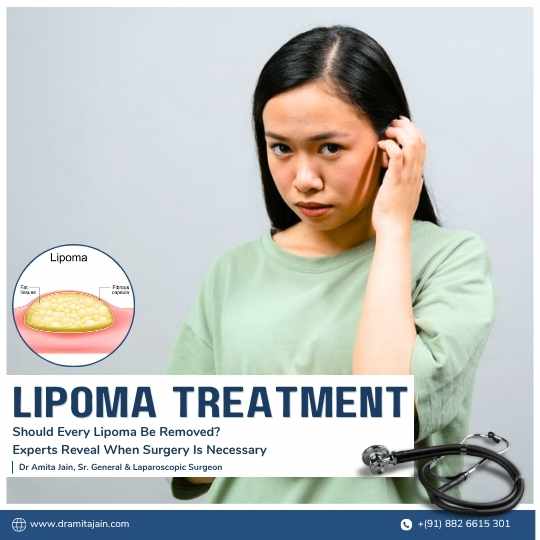
Understanding Lipomas
A lipoma is a benign tumour made up of fat cells. It usually feels soft, moves easily beneath the skin, and grows very slowly. These growths commonly appear on the neck, shoulders, arms, back, thighs, and abdomen.
Although anyone can develop a lipoma, they are more frequently seen in adults between the ages of 40 and 60. Some people may also have a family history of multiple lipomas.
Signs That Surgery May Be Recommended
Not all lipomas behave the same way. Some remain unchanged throughout life, while others continue to enlarge. A growing lipoma may begin pressing against muscles, nerves, or surrounding tissues, causing discomfort or restricting movement.
Pain, rapid enlargement, firmness, or changes in the lump’s appearance should always be evaluated by an experienced surgeon. Lipomas that interfere with clothing, sleeping positions, or daily activities are also good candidates for surgical removal.
Importance of Proper Diagnosis
Every lump beneath the skin should be assessed carefully before deciding on treatment. While most lipomas can be diagnosed during a physical examination, larger or deeper lumps may require an ultrasound or MRI scan.
These investigations help determine the exact size, depth, and nature of the swelling. A proper diagnosis ensures that the treatment plan is both safe and appropriate.
Benefits of Early Removal
When surgery is necessary, early removal often makes the procedure simpler. Smaller lipomas are generally easier to remove and may require a smaller incision. Early treatment can also prevent future discomfort, improve cosmetic appearance, and reduce anxiety associated with watching the lump grow over time.
Most importantly, surgical removal provides complete confirmation of the diagnosis through laboratory examination of the tissue.
Recovery After Lipoma Surgery
Lipoma removal is usually a minor surgical procedure performed under local or general anaesthesia depending on the size and location of the lump. Patients can often return home the same day and resume normal activities within a short period.
Following the surgeon’s postoperative instructions helps ensure smooth healing while minimising the risk of infection or recurrence.
When You Should Consult a Surgeon?
Many people ignore a lipoma because it is painless. However, any lump that changes in size, causes discomfort, or develops suddenly deserves medical evaluation. Consulting a qualified surgeon helps determine whether simple observation is sufficient or whether surgical removal is the better option. Early consultation provides reassurance and prevents unnecessary complications in the future.

Dr Amita Jain is one of India’s most distinguished and experienced female surgeons and proctologists, known for her unmatched expertise in general, advanced laparoscopic, and laser proctology surgery. With over 30 years of surgical excellence, Dr Amita Jain has built a reputation for precision, compassionate care, and advanced surgical techniques.
Dr Jain has successfully performed a wide range of complex general surgeries, including both open and minimally invasive procedures, with a strong focus on trauma care, onco-surgical techniques, and reconstructive surgeries. Her medical specialisation includes: gallbladder surgeries, appendix removal surgeries, hernia repair surgeries, Pilonidal Sinus treatments, varicose vein and piles surgeries, fistula surgeries and fissure surgeries.
Dr Jain, currently serves as Senior Consultant and Head of Department (General, Laser, Proctology and Laparoscopic Surgeries) across premier medical networks in South Delhi:
Daffodils by Artemis Hospitals: Spring Meadows, East of Kailash, New Delhi. Book Appointment
Fortis C-DOC Hospital: B-16, Chirag Enclave, New Delhi. Book Appointment
Rosewalk Luxury Multi-Specialty & Maternity Hospital: Panchsheel Park, New Delhi. Book Appointment
Rainbow Children’s Hospital: Malviya Nagar, New Delhi. Book Appointment
Learn More about Dr Amita Jain.
Dr Amita Jain has also authored some of the key medical journals and publications, like ResearchGate, IJSR
Note: This article is written and reviewed by Dr Amita Jain, while referring to her medical journals and publications.