Piles, also known as haemorrhoids, are a common anorectal condition that affects millions of people worldwide. While conventional surgery has been a treatment option for decades, advancements in medical technology have introduced laser treatment for piles — a modern, minimally invasive alternative that offers faster recovery and less discomfort.
With growing awareness, more patients today are opting for laser procedures over traditional surgical methods. But what exactly is laser treatment for piles, and why is it considered better? Let’s find out, as explained by Dr Amita Jain, a top senior general surgeon and one of the best doctors and surgeons for painless laser surgery for piles in Delhi and India.
What Are Piles?
Piles are swollen and inflamed veins in the rectum and rectum that cause discomfort, pain, itching, and sometimes bleeding during bowel movements. They can be internal (inside the rectum) or external (under the skin around the rectum).
Common causes of piles include:
- Chronic constipation or diarrhoea
- Straining during bowel movements
- Sedentary lifestyle
- Pregnancy
- Low-fiber diet
In mild cases, piles can be managed through lifestyle changes, dietary adjustments, and medications. However, in moderate to severe cases — especially when there is persistent pain, bleeding, or prolapse — surgical intervention may be necessary.
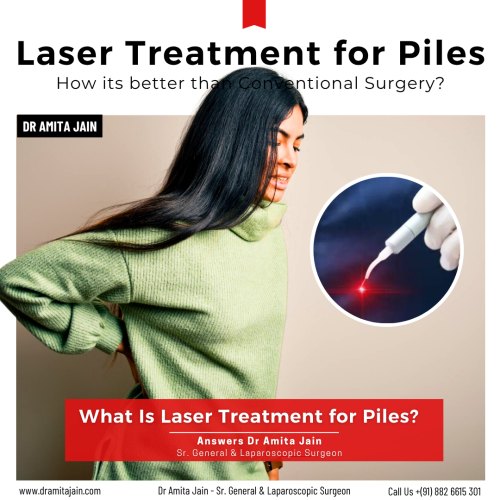
What Is Laser Treatment for Piles?
Laser treatment for piles, also known as laser hemorrhoidoplasty, is a minimally invasive surgical procedure that uses a highly focused laser beam to shrink or remove the hemorrhoidal tissue.
Here’s how it works:
Precise Energy Delivery – A laser probe targets only the affected tissue without harming surrounding healthy tissues.
Controlled Heat – The laser energy causes the hemorrhoidal mass to shrink and seals off the blood vessels, reducing the risk of bleeding.
Minimal Tissue Damage – Since there is no physical cutting, the procedure results in less pain and quicker healing.
The procedure usually takes 15–30 minutes and is performed under local, spinal, or general anaesthesia, depending on the case.

How Is Laser Treatment Better Than Conventional Surgery?
Minimally Invasive & Less Painful
Conventional surgery involves cutting and removing the hemorrhoidal tissue, which can cause significant post-operative pain. Laser treatment uses focused light energy, resulting in minimal tissue damage and much less discomfort.
Faster Recovery Time
Patients undergoing conventional hemorrhoidectomy may require 2–4 weeks to recover fully. With laser treatment, recovery time is much shorter — often allowing patients to resume normal activities within 3–5 days.
Minimal Bleeding
Laser energy instantly seals blood vessels during the procedure, drastically reducing intraoperative and postoperative bleeding compared to conventional methods.
Lower Risk of Infection
Since the procedure involves no open wounds and is performed with sterile laser equipment, the risk of infection is much lower.
No or Minimal Scarring
Conventional surgery may leave visible scars, whereas laser treatment typically results in little to no scarring.
High Precision & Safety
The laser allows surgeons to work with extreme precision, targeting only the affected tissue without harming surrounding areas.
Outpatient Procedure
Most laser pile treatments are done on a daycare basis, meaning patients can go home the same day, unlike conventional surgery, which often requires hospitalisation. Laser treatment for piles offers a safer, faster, and more comfortable alternative to conventional surgery. While not every case may be suitable for this method, it is an excellent option for many patients seeking minimal pain, quicker recovery, and reduced complications. If you’re experiencing symptoms of piles, consult a qualified colorectal surgeon to determine the best treatment option for your condition.
Also, read about treatments for severe or recurrent piles issues: Read more

Dr Amita Jain, one of the most experienced General and Laparoscopic Surgeons in Delhi, is widely recognised for her expertise in hernia, piles, gallbladder, fissure, and fistula surgeries. With an outstanding career spanning over 29 years, Dr Amita Jain has earned her place among the top General and Laparoscopic surgeons in Delhi and India, known for her precision, compassion, and consistent surgical excellence. She was the Professor of Surgery at the Army College of Medical Sciences and Base Hospital, Delhi Cantt. In 1994, she was commissioned as a surgeon under the United Nations Mission in Congo.
Dr Amita Jain currently serves as the Head of Department, Laparoscopic and Trauma Surgery at Artemis Lite Hospital (Delhi), Senior General and Laparoscopic Surgeon at Rosewalk – Luxury Maternity Hospital in Delhi and Rainbow Children Hospitals (at Malviya Nagar and Panchsheel Park, New Delhi)
Dr Amita Jain has successfully performed a wide range of complex general surgeries, including both open and minimally invasive procedures, with a strong focus on trauma care, onco-surgical techniques, and reconstructive surgeries. Her medical specialisation includes – Gallbladder surgeries, appendix removal surgeries, hernia repair surgeries, Pilonidal Sinus treatments, varicose vein and piles surgeries, fistula surgeries and fissure surgeries.
Dr Amita Jain has also authored some of the key medical journals and publications, like ResearchGate, IJSR
Note: the articles are written with Dr Amita Jain’s professional insights and referring to her medical publications.