The gallbladder is a small but important organ situated under the liver. Its primary role is to store bile, which is released into the digestive tract to help break down dietary fats. While gallstones and inflammation are the most commonly discussed issues, some people are told after an ultrasound or CT scan that they have a collapsed gallbladder or even a vanishing gallbladder.
These terms can sound alarming, but they describe specific situations that require careful interpretation. Understanding what they mean and how they are treated is essential for proper management and peace of mind, explains Dr Amita Jain, a top senior general and laparoscopic surgeon and one of the most experienced surgeons for gallbladder stone removal surgery in India.
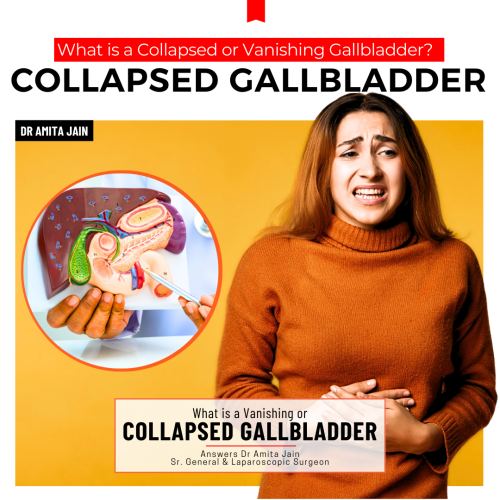
What is a Collapsed Gallbladder?
A collapsed gallbladder simply means that the organ has contracted and is very small in size at the time of imaging. This can be a normal finding if the gallbladder has already released bile after a meal, since it naturally shrinks when empty.
However, a collapsed appearance may also occur in cases of gallstones, scarring, or chronic gallbladder inflammation, where the walls become thickened and the organ cannot expand properly. In some situations, especially during acute infection, the gallbladder can also collapse due to obstruction or spasm. Radiologists often consider the timing of food intake and the patient’s symptoms before deciding whether a collapsed gallbladder is normal or a sign of disease.
What is a Vanishing Gallbladder?
A vanishing gallbladder is a term used when the gallbladder cannot be seen clearly on ultrasound or other imaging tests. There are several possible reasons for this. Some people are born without a gallbladder, a condition known as congenital agenesis. Others may have had the gallbladder surgically removed in the past.
In certain cases, long-standing inflammation leads to fibrosis and scarring, which causes the gallbladder to shrink and blend with nearby tissues, making it hard to detect. Sometimes the gallbladder is simply obscured due to bowel gas, body habitus, or technical limitations of the scan. Because of this, a vanishing gallbladder does not always mean disease, but it often requires further imaging with MRI or other techniques for confirmation.
Treatment for a Collapsed Gallbladder
The treatment for a collapsed gallbladder depends entirely on the underlying cause. If the organ is collapsed because the patient has eaten recently, then no treatment is needed since this is part of normal physiology. If the collapse is linked to gallstones or chronic cholecystitis, surgical removal of the gallbladder, also known as laparoscopic cholecystectomy, is usually recommended to relieve pain and prevent complications.
In cases where the collapse is associated with acute infection, patients may require hospitalisation, intravenous antibiotics, pain management, and, in some cases, emergency surgery. Supportive care, including a low-fat diet, weight management, and lifestyle changes, can also help reduce stress on the gallbladder and prevent recurrent symptoms.
Treatment for a Vanishing Gallbladder
When the gallbladder is described as vanishing, management depends on the specific reason it cannot be visualised. If a person was born without a gallbladder, no treatment is needed unless there are digestive symptoms, in which case dietary adjustments and medications for bile reflux may help. If the gallbladder has already been removed surgically, again, no treatment is required, though patients may benefit from smaller, low-fat meals to improve digestion.
In cases where the gallbladder has become scarred or fibrosed after years of chronic inflammation, surgery can be considered, although it may be technically difficult. If the vanishing appearance is due to poor imaging quality, further evaluation with MRI, CT scan, or specialised nuclear medicine scans is usually recommended.
A collapsed gallbladder usually indicates contraction, which can be normal after eating or related to disease, while a vanishing gallbladder means that the organ is not visible, either because it is absent, removed, scarred, or hidden on imaging. Treatment options range from no intervention to surgery, depending on the underlying cause and the severity of symptoms.
Note – Medically Reviewed by Dr. Amita Jain | Senior General and Laparoscopic Surgeon & HOD Artemis Lite | Updated February 2026.

Dr Amita Jain is one of India’s most distinguished and experienced female surgeons and proctologists, known for her unmatched expertise in general, advanced laparoscopic, and laser proctology surgery. With over 30 years of surgical excellence, Dr Amita Jain has built a reputation for precision, compassionate care, and advanced surgical techniques.
Dr Jain has successfully performed a wide range of complex general surgeries, including both open and minimally invasive procedures, with a strong focus on trauma care, onco-surgical techniques, and reconstructive surgeries. Her medical specialisation includes: gallbladder surgeries, appendix removal surgeries, hernia repair surgeries, Pilonidal Sinus treatments, varicose vein and piles surgeries, fistula surgeries and fissure surgeries.
Dr Jain, currently serves as Senior Consultant and Head of Department (General, Laser, Proctology and Laparoscopic Surgeries) across premier medical networks in South Delhi:
Daffodils by Artemis Hospitals: Spring Meadows, East of Kailash, New Delhi. Book Appointment
Fortis C-DOC Hospital: B-16, Chirag Enclave, New Delhi. Book Appointment
Rosewalk Luxury Multi-Specialty & Maternity Hospital: Panchsheel Park, New Delhi. Book Appointment
Rainbow Children’s Hospital: Malviya Nagar, New Delhi. Book Appointment
Learn More about Dr Amita Jain.
Dr Amita Jain has also authored some of the key medical journals and publications, like ResearchGate, IJSR
Note: This article is written and reviewed by Dr Amita Jain, while referring to her medical journals and publications.