A ventral hernia is a common surgical condition that affects the abdominal wall and can occur in people of all age groups. It often develops silently and becomes noticeable only when a visible bulge or discomfort appears.
While some ventral hernias may remain small and painless initially, others can grow over time and lead to complications if left untreated. Understanding what a ventral hernia is, why it occurs, and how it is treated helps in early diagnosis and timely medical care as shared by Dr Amita Jain who is an experienced general and laparoscopic ventral hernia surgeon specialist in Delhi.
What Is a Ventral Hernia?
A ventral hernia occurs when an organ or tissue pushes through a weak area or defect in the abdominal wall muscles. It usually appears as a soft bulge on the abdomen that becomes more prominent while standing, coughing, or straining.
Ventral hernias can develop at any location along the front abdominal wall and are often classified based on their location, such as umbilical hernia near the navel or incisional hernia at the site of a previous surgical scar says Dr Amita Jain who is a leading general and laparoscopic surgeon in Delhi.
The abdominal wall normally acts as a strong barrier that keeps internal organs in place. When this wall weakens, pressure from inside the abdomen forces tissue outward, forming a hernia. Unlike some minor conditions, a ventral hernia does not heal on its own and tends to increase in size over time.
Causes of Ventral Hernia
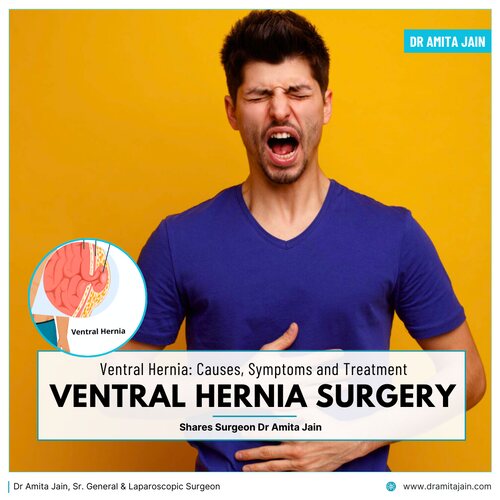
The primary cause of a ventral hernia is weakness in the abdominal muscles combined with increased pressure inside the abdomen.
This weakness may be present from birth or develop later in life. One of the most common causes is previous abdominal surgery, where the surgical incision does not heal strongly, leading to an incisional hernia.
Other contributing factors include obesity, heavy lifting, chronic coughing, constipation, and conditions that cause repeated straining.
Pregnancy can also stretch and weaken abdominal muscles, increasing the risk. In some individuals, aging and poor muscle tone reduce the strength of the abdominal wall, making it more vulnerable to herniation.
Symptoms of Ventral Hernia
The most noticeable symptom of a ventral hernia is a visible or palpable bulge on the abdomen. This bulge may disappear when lying down and reappear during physical activity or strain.
Some people experience mild discomfort, pressure, or a dragging sensation, especially after prolonged standing or exertion.
As the hernia grows, pain may increase and daily activities can become uncomfortable. In severe cases, sudden pain, redness, nausea, or vomiting may indicate complications such as incarceration or strangulation, where the trapped tissue loses its blood supply. These symptoms require immediate medical attention.
How Ventral Hernia Is Diagnosed?
Diagnosis of a ventral hernia is primarily based on a physical examination. A doctor may ask the patient to cough or strain to make the hernia more visible. Imaging tests such as ultrasound, CT scan, or MRI may be advised in certain cases to assess the size of the hernia and plan treatment, especially for larger or complex hernias.
Treatment Options for Ventral Hernia
Surgery is the only definitive treatment for a ventral hernia. The goal of surgery is to push the protruding tissue back into place and repair the weakened abdominal wall. Small, asymptomatic hernias may be monitored for a period, but surgery is generally recommended to prevent complications.
Modern surgical techniques include open hernia repair and minimally invasive laparoscopic or robotic surgery. In many cases, a surgical mesh is used to strengthen the abdominal wall and reduce the risk of recurrence. Minimally invasive approaches often result in smaller incisions, less postoperative pain, faster recovery, and lower infection rates.
Recovery and Prevention
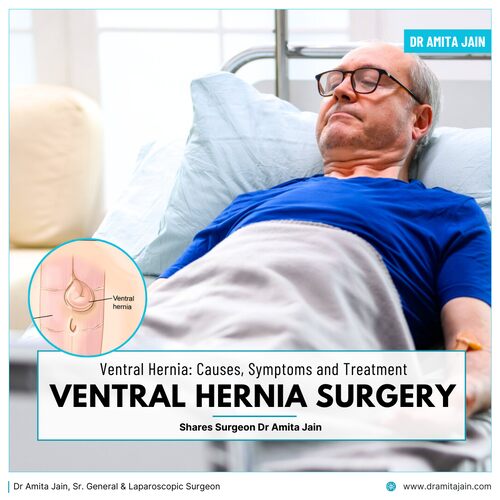
Recovery time depends on the size of the hernia and the type of surgery performed. Most patients are encouraged to walk soon after surgery but advised to avoid heavy lifting for several weeks. Maintaining a healthy weight, strengthening core muscles, and managing chronic cough or constipation can help reduce the risk of recurrence.
A ventral hernia is a progressive condition that should not be ignored. While it may begin with mild symptoms, it can worsen and lead to serious complications without treatment. Early diagnosis and timely surgical intervention offer the best outcomes. With advances in hernia repair techniques, ventral hernia surgery is safe, effective, and allows patients to return to normal life with improved comfort and confidence.

Dr Amita Jain is one of India’s most distinguished and experienced female surgeons and proctologists, known for her unmatched expertise in general, advanced laparoscopic, and laser proctology surgery. With over 30 years of surgical excellence, Dr Amita Jain has built a reputation for precision, compassionate care, and advanced surgical techniques.
Dr Jain has successfully performed a wide range of complex general surgeries, including both open and minimally invasive procedures, with a strong focus on trauma care, onco-surgical techniques, and reconstructive surgeries. Her medical specialisation includes: gallbladder surgeries, appendix removal surgeries, hernia repair surgeries, Pilonidal Sinus treatments, varicose vein and piles surgeries, fistula surgeries and fissure surgeries.
Dr Jain, currently serves as Senior Consultant and Head of Department (General, Laser, Proctology and Laparoscopic Surgeries) across premier medical networks in South Delhi:
Daffodils by Artemis Hospitals: Spring Meadows, East of Kailash, New Delhi. Book Appointment
Fortis C-DOC Hospital: B-16, Chirag Enclave, New Delhi. Book Appointment
Rosewalk Luxury Multi-Specialty & Maternity Hospital: Panchsheel Park, New Delhi. Book Appointment
Rainbow Children’s Hospital: Malviya Nagar, New Delhi. Book Appointment
Learn More about Dr Amita Jain.
Dr Amita Jain has also authored some of the key medical journals and publications, like ResearchGate, IJSR
Note: This article is written and reviewed by Dr Amita Jain, while referring to her medical journals and publications.