General Surgeon’s Direct Answer Summary
- Postoperative pain does not automatically indicate surgical failure: Inflammation, tissue healing, nerve irritation, and muscle stiffness can cause discomfort after an otherwise successful operation.
- Worsening symptoms require medical attention: Fever, increasing pain, wound discharge, chest pain, or breathing difficulties should be evaluated promptly.
- Recovery requires continued monitoring: Follow-up consultations, appropriate medication, gradual physical activity, and communication with the surgeon are essential for safe recovery.
Article Medically Reviewed by Dr Amita Jain, MBBS, MS (Gen Surgery), Fellowship (AIIMS), Military-Precision Sr. General Surgeon, and Laparoscopy Surgeon, Proctologist: 30 Years of Surgical Excellence by Ex-Indian Army Surgeon
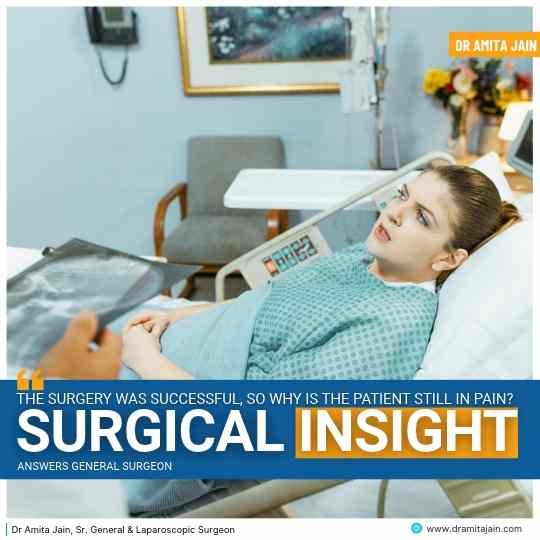
A successful surgery is generally measured by whether the intended medical problem has been addressed, the procedure has been completed safely, and the patient is recovering as expected. However, some patients continue to experience pain even after their surgeon confirms that the operation was successful. This can create confusion and anxiety, particularly when they expected the discomfort to disappear immediately after surgery.
Postoperative pain does not necessarily indicate surgical failure or a complication. The body needs time to heal after an operation, and discomfort can persist due to tissue inflammation, nerve irritation, muscle recovery, or the original condition. The duration and intensity of pain depend on the type of surgery, the patient’s health, the extent of tissue involvement, and individual healing responses.
Understanding why pain continues after an apparently successful operation helps patients distinguish between expected recovery discomfort and symptoms that require further medical evaluation, explains Delhi’s one of the highly experienced Sr general and laparoscopic surgeon Dr Amita Jain.
Why Can Pain Continue Even After a Successful Surgery?
Surgery involves more than correcting the underlying medical problem. Depending on the procedure, it may involve incisions, tissue manipulation, removal of affected structures, or internal sutures. These interventions can trigger the body’s natural inflammatory and healing responses.
During recovery, patients may experience soreness, tenderness, swelling, or discomfort around the operated area. Even minimally invasive procedures involving small incisions can cause internal tissue irritation.
For example, a patient undergoing laparoscopic gallbladder removal may experience abdominal soreness, shoulder discomfort due to residual carbon dioxide gas, or tenderness around the incision sites.
Similarly, patients recovering from hernia repair may experience pulling sensations or discomfort while moving, coughing, or changing positions.
Such symptoms can occur during normal healing, although their expected duration varies between procedures and individuals.
“A successful surgery addresses the problem, but complete recovery takes time. Persistent pain deserves attention, proper evaluation, and an individualised recovery plan.” Says Sr General Surgeon Dr Amita Jain.
What Are the Common Reasons for Persistent Pain After Surgery?
Several factors can contribute to discomfort after an operation, even when the intended surgical outcome has been achieved.
1. Inflammation and Tissue Healing
The body’s inflammatory response is an essential part of recovery. Swelling and tenderness can develop around the operated tissues as the body repairs itself. This discomfort generally improves gradually as healing progresses.
2. Nerve Irritation or Sensitivity
Surgery can sometimes irritate small nerves near the operated area. Patients may experience burning, tingling, shooting sensations, or increased sensitivity. In some cases, nerve-related pain can persist longer than ordinary postoperative soreness.
3. Muscle Stiffness and Reduced Mobility
Patients may avoid movement because of discomfort following surgery. Reduced physical activity can contribute to muscle stiffness and weakness, making everyday movements uncomfortable. Gradually increasing activity according to medical advice can help restore mobility.
4. Scar Tissue Formation
As surgical wounds heal, scar tissue develops. In certain situations, internal adhesions or changes in tissue flexibility may contribute to discomfort. Not every patient develops symptomatic adhesions, and persistent pain should be evaluated rather than automatically attributed to scar tissue.
5. Pre-existing Pain Conditions
Sometimes, the original condition may have caused prolonged pain or altered the body’s pain response before surgery. Even after the underlying problem is corrected, the nervous system may continue to register discomfort for some time.
When Should Postoperative Pain Become a Concern?
Although some pain is expected after surgery, worsening or unusual symptoms should never be ignored. Patients should contact their treating surgeon if discomfort is increasing instead of gradually improving or interfering significantly with recovery.

Certain warning signs require prompt medical attention:
- Increasing pain accompanied by fever or chills.
- Excessive redness, swelling, or discharge around the surgical wound.
- Persistent vomiting or significant abdominal swelling.
- New breathing difficulties or chest pain.
- Severe pain that does not respond to prescribed medication.
Sudden chest pain, difficulty breathing, or severe deterioration requires emergency medical assessment.
Patients should not assume that all postoperative discomfort is part of normal healing. A clinical examination may be necessary to rule out infection, bleeding, wound problems, blood clots, or other complications.
Does Persistent Pain Mean the Surgery Has Failed?
Not necessarily. Surgical success and complete pain relief are two different outcomes.
An operation may successfully remove an obstruction, repair a hernia, or remove an inflamed organ, while the surrounding tissues still require time to recover.
However, persistent or recurrent symptoms may sometimes indicate that the original problem has not been completely resolved, another condition is contributing to the discomfort, or a postoperative complication has developed.
The surgeon may recommend a physical examination, blood investigations, ultrasound, CT scan, or other tests depending on the patient’s symptoms and surgical history.
The important consideration is whether pain is following an expected recovery pattern or requires further investigation.
How Can Patients Manage Pain During Surgical Recovery?
Postoperative recovery should follow an individualized plan recommended by the treating surgeon.
Patients can support healing by taking prescribed medications correctly, keeping surgical wounds clean, maintaining adequate nutrition and hydration, and gradually returning to physical activity.
They should avoid lifting heavy objects or undertaking strenuous exercise until medically cleared. Follow-up appointments are equally important because they allow the surgeon to assess wound healing, mobility, and pain progression.
Patients should also communicate openly about the location, intensity, frequency, and nature of their discomfort. These details help the surgeon determine whether the symptoms are consistent with normal healing or require additional evaluation.
General Surgeon’s Perspective: Successful Surgery Is Only One Part of Recovery
A successful operation is an important milestone, but recovery does not end when the patient leaves the operating theater. Healing involves several stages, and discomfort can continue while the body repairs itself.
As a general surgical principle, persistent pain should neither create unnecessary panic nor be dismissed without assessment. The patient’s symptoms, surgical procedure, recovery timeline, and clinical findings must be considered together.
This article is intended for general awareness and does not replace an individual medical assessment.
The 4 Essential Postoperative Pain FAQs
A: No. Surgical success and complete pain relief are two separate outcomes occurring on different timelines.
Clinical Detail:
An operation is considered successful when the primary surgical objective is achieved—such as removing an inflamed gallbladder, safely repairing a hernia defect, or relieving an internal obstruction. However, completing the surgery safely does not bypass the body’s natural biological healing requirements.
Surrounding tissues, skin layers, fascia, and internal structures undergo physical manipulation, cutting, and suturing during an operation. Even when the root problem is 100% resolved, these tissues remain inflamed, swollen, and biologically active as they knit back together. Persistent discomfort is standard during this rebuilding phase.
Pain only suggests a complication or incomplete resolution if it follows an abnormal trajectory—such as steadily escalating several days post-op rather than gradually diminishing, or when accompanied by systemic warning signs like fever, spreading redness, or persistent vomiting.
Key Takeaway: A successful surgery fixes the mechanical or diseased problem; your body still requires weeks to repair the surgical path taken to reach it.
Patient Action: Track whether your pain is following an overall downward trend week-over-week rather than expecting day-to-day instantaneous disappearance.
A: Internal tissue irritation, residual surgical gas, and muscle guarding frequently cause discomfort in unexpected areas.
Clinical Detail:
Discomfort after surgery is rarely confined to the surface incision. Postoperative pain extends to surrounding and even distant areas due to specific physiological mechanisms:
1. Laparoscopic Procedures & Referred Shoulder Pain: In minimally invasive surgeries (such as laparoscopic cholecystectomy or appendectomy), carbon dioxide (CO2) gas is used to gently inflate the abdominal cavity to provide surgical visualization. Residual pockets of gas irritate the phrenic nerve near the diaphragm. Because this nerve shares pathways with cervical nerves, your brain registers the discomfort as pain in the right shoulder tip or neck. This is completely normal and dissipates within 48 to 72 hours as the gas absorbs.
2. Hernia Repair & Tugging Sensations: In hernia repairs, mesh placement and internal anchoring sutures reinforce the abdominal wall. Changing positions, coughing, or standing engages these core muscle groups, creating sharp pulling or tugging sensations while the mesh incorporates into your tissue.
3. Muscle Stiffness & Postural Compensation: Patients naturally guard painful areas by staying rigid or moving unnaturally. This immobilization leads to secondary muscle stiffness and back or joint aches.
Key Takeaway: Referred gas pain (shoulder) and internal suture pulling (hernia/abdominal wall) are hallmarks of normal healing, not surgical error.
Patient Action: For laparoscopic shoulder discomfort, gentle walking aids gas re absorption. For hernia pulling, support your incision with a small pillow when coughing or sneezing.
A: Surgeons identify 5 primary drivers: tissue inflammation, nerve sensitivity, muscle stiffness, scar tissue/adhesions, and pre-existing pain pathways.
Clinical Detail:
A general surgeon categorizes persistent postoperative pain into five well-recognized clinical drivers:
1. Inflammation and Tissue Healing: The body floods the surgical site with inflammatory mediators, fluids, and repair cells. This protective biological cascade causes localized swelling, warmth, and throbbing tenderness that subsides as tissue matrix remodels.
2. Nerve Irritation or Sensitivity: Incisions inevitably cross microscopic sensory nerve endings. As these nerve fibers regenerate, they can fire spontaneously, producing tingling, ‘electric’ twinges, burning, numbness, or heightened skin sensitivity (hyperalgesia) that can outlast blunt muscle soreness.
3. Muscle Stiffness and Reduced Mobility: Inactivity to protect the surgical site leads to muscle splinting, shortened fibers, and joint stiffness, making subsequent movement uncomfortable.
4. Scar Tissue and Internal Adhesions: Healing creates collagen-rich scar tissue. In certain areas, bands of tissue or changed elasticity cause internal tension during stretching.
5. Pre-existing Pain Sensitization: If a patient endured chronic pain prior to surgery (such as prolonged gallbladder attacks or strangulated hernia pain), the central nervous system may remain ‘sensitized’ or primed to transmit pain signals even after the anatomical trigger has been excised.
Key Takeaway: Tissue repair, nerve re-sprouting, and neuroplastic memory all generate distinct sensations as your body re-calibrates.
Patient Action: Note the specific sensation you feel (e.g., burning vs. aching vs. pulling); this helps your surgeon precisely identify which of the 5 mechanisms is at play.
A: Pain that escalates instead of improving, or that is accompanied by fever, wound drainage, vomiting, or breathing trouble, requires immediate clinical evaluation.
Clinical Detail:
While predictable, decreasing discomfort is expected, any deviation toward escalating pain or systemic distress should never be dismissed as ‘just part of recovery.’
You should promptly contact your surgical team or seek emergency medical care if you observe any of the following critical warning signs:
• Escalating Pain: Pain that is progressively worsening day-by-day rather than gradually subsiding, or severe breakthrough pain that does not respond to prescribed analgesics.
• Wound Infection Indicators: Spreading redness beyond incision borders, marked heat, increasing localized swelling, or yellowish/cloudy or foul-smelling wound discharge.
• Systemic Infection Signs: Fever (temperature over 38°C / 100.4°F), persistent chills, or shivering.
• Gastrointestinal Warning Signs: Inability to keep fluids down, persistent vomiting, or significant, tense abdominal distension.
• Cardiopulmonary Emergencies (Seek Immediate Emergency Care / ER): Sudden shortness of breath, sharp pleuritic chest pain, coughing up blood, or sudden swelling and pain in one calf (indicators of pulmonary embolism or deep vein thrombosis).
A prompt clinical examination, ultrasound, blood tests, or CT scan may be performed to definitively rule out infection, hematoma, internal leak, or deep clot.
Key Takeaway: Pain that is steadily increasing, refractory to meds, or joined by fever or wound discharge is a red flag requiring prompt surgeon assessment.
Patient Action: Do not wait for your scheduled 2-week checkup if red-flag symptoms arise. Contact your surgeon’s on-call clinical nurse or clinic immediately.

Dr Amita Jain is one of India’s most distinguished and experienced female surgeons and proctologists, known for her unmatched expertise in general, advanced laparoscopic, and laser proctology surgery. With over 30 years of surgical excellence, Dr Amita Jain has built a reputation for precision, compassionate care, and advanced surgical techniques.
Dr Jain has successfully performed a wide range of complex general surgeries, including both open and minimally invasive procedures, with a strong focus on trauma care, onco-surgical techniques, and reconstructive surgeries. Her medical specialisation includes: gallbladder surgeries, appendix removal surgeries, hernia repair surgeries, Pilonidal Sinus treatments, varicose vein and piles surgeries, fistula surgeries and fissure surgeries.
Dr Jain, currently serves as Senior Consultant and Head of Department (General, Laser, Proctology and Laparoscopic Surgeries) across premier medical networks in South Delhi:
Daffodils by Artemis Hospitals: Spring Meadows, East of Kailash, New Delhi. Book Appointment
Fortis C-DOC Hospital: B-16, Chirag Enclave, New Delhi. Book Appointment
Rosewalk Luxury Multi-Specialty & Maternity Hospital: Panchsheel Park, New Delhi. Book Appointment
Rainbow Children’s Hospital: Malviya Nagar, New Delhi. Book Appointment
Learn More about Dr Amita Jain.
Dr Amita Jain has also authored some of the key medical journals and publications, like ResearchGate, IJSR
Note: This article is written and reviewed by Dr Amita Jain, while referring to her medical journals and publications.