Proctologist’s Direct Answer Summary
- Smartphone scrolling can extend toilet visits and encourage unnecessarily prolonged sitting.
- Research has identified an association between toilet smartphone use and hemorrhoids, but it has not established direct causation.
- Limit toilet time, avoid straining and seek medical advice for persistent discomfort or bleed
Article Medically Reviewed by Dr Amita Jain, MBBS, MS (Gen Surgery), Fellowship (AIIMS), Military-Precision Sr. General Surgeon, and Laparoscopy Surgeon, Proctologist: 30 Years of Surgical Excellence by Ex-Indian Army Surgeon
For many people, a visit to the toilet is no longer just a bathroom break. It has become an opportunity to check messages, scroll through social media, watch short videos or catch up on the news. What begins as a quick visit can easily turn into 10 or 15 minutes of sitting with a smartphone.
While this habit may seem harmless, spending excessive time on the toilet can have implications for bowel health. Prolonged sitting on the toilet, particularly when accompanied by straining, can increase pressure around the lower rectal region and may contribute to problems such as hemorrhoids (piles). The concern is not the smartphone itself, but the extra time it encourages people to spend sitting on the toilet shares Dr Amita Jain a Sr General and Laparoscopic Surgeon, Specialized in Proctology procedures in Delhi.
Can Sitting Too Long on the Toilet Increase the Risk of Piles?
The toilet is designed for a specific purpose, not extended sitting. Unlike sitting on a regular chair, the position adopted during a bowel movement can place additional pressure on the blood vessels around the lower rectum and anus.
When someone remains seated long after passing stool, this pressure may persist. Repeated prolonged toilet sessions, especially when combined with constipation and straining, can contribute to the development or worsening of hemorrhoids.
Hemorrhoids are swollen blood vessels in the lower rectum or around the anus. Common symptoms include bleeding during bowel movements, itching, discomfort, swelling and pain.
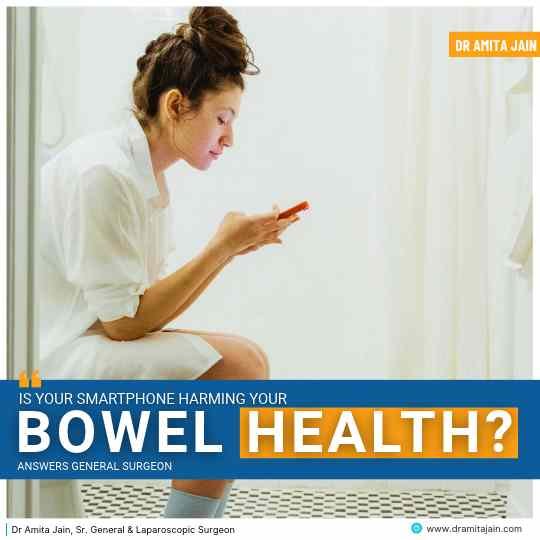
However, spending 10 minutes on the toilet does not automatically mean someone will develop piles. Risk depends on several factors, including bowel habits, diet, hydration, physical activity, age and individual medical history.
Why Does Scrolling Make Bathroom Visits Longer?
Smartphones are designed to hold attention. Social media feeds, notifications, videos and endless scrolling can make it difficult to recognise how much time has passed.
Without a phone, most people are more likely to finish their bowel movement and leave the bathroom. With a smartphone, they may continue sitting even after they have finished.
Another concern is distraction. Some people may ignore their body’s natural signals or delay responding to the urge to pass stool because their attention is occupied elsewhere. Over time, irregular bowel habits can make maintaining a comfortable routine more difficult.
The key distinction is that smartphone use does not directly cause bowel disease. Rather, it can encourage habits that are unfavorable for bowel health.
Is Straining More Harmful Than Scrolling?
Straining is an important factor in many cases of hemorrhoids. When a person pushes excessively to pass hard stool, pressure increases around the blood vessels in the lower rectal region.
Repeated straining can aggravate existing hemorrhoids and may contribute to symptoms such as bleeding, swelling and discomfort.
Constipation is often associated with inadequate fiber intake, insufficient fluid consumption, low physical activity and certain medications. Spending more time on the toilet does not necessarily make a bowel movement easier.
If stool is difficult to pass regularly, the underlying cause should be addressed rather than attempting to force a bowel movement.
How Can You Develop Healthier Toilet Habits?
Improving bowel habits does not require complicated changes. A few simple practices can help reduce unnecessary pressure and support regular bowel movements.
- Leave your phone outside: Avoid distractions that encourage prolonged toilet sitting.
- Respond to natural urges: Do not repeatedly postpone bowel movements when you feel the need to go.
- Avoid excessive straining: Give yourself time, but do not force stool to pass.
- Increase dietary fiber: Include vegetables, fruits, whole grains, pulses and other fiber-rich foods.
- Stay hydrated: Drink adequate fluids throughout the day, unless your doctor has advised a fluid restriction.
- Remain physically active: Regular walking and exercise can support normal bowel function.
Most importantly, avoid treating the toilet as a place to spend leisure time. Once the bowel movement is complete, get up rather than continuing to scroll.
What Does Research Say About Smartphone Use on the Toilet?
A 2025 study published in PLOS One examined smartphone habits and hemorrhoid prevalence among 125 adults undergoing screening colonoscopy. Around 66% reported using smartphones while on the toilet. Researchers found that 37.3% of smartphone users spent more than five minutes per visit, compared with 7.1% of non-users.
The study also reported that smartphone use was associated with a 46% higher likelihood of hemorrhoids after adjusting for several factors, including age, gender, body mass index, physical activity, straining and fiber intake.
However, an important distinction must be made: this was a relatively small, cross-sectional study. It identified an association, not proof that smartphone use directly causes hemorrhoids. Larger studies are needed to establish whether prolonged phone use contributes to the development of the condition.
When Should You Consult a Proctologist?
Occasional constipation or discomfort may improve with changes in diet, hydration and toilet habits. However, certain symptoms should not be ignored.
Consult a healthcare professional if you experience:
- Repeated bleeding during or after bowel movements.
- Persistent itching, swelling or discomfort.
- Pain while passing stool or a recurring sensation of incomplete evacuation.
- A lump or swelling around the affected area.
Bleeding should never automatically be attributed to piles. Other digestive conditions can produce similar symptoms, so proper examination is important. Persistent or unexplained symptoms require medical evaluation.
A Small Habit Worth Changing
Your smartphone may be an essential part of everyday life, but the toilet is not the ideal place for extended screen time. Keeping the phone away, avoiding unnecessary sitting and maintaining healthy bowel habits are simple steps that can support better digestive and anorectal health.
Proctologist’s Perspective
“Healthy bowel habits are often shaped by small everyday decisions. Avoiding prolonged toilet sitting, preventing constipation and responding naturally to the urge to pass stool can help reduce unnecessary pressure and support long-term bowel health.” Says Dr Amita Jain a Sr. Proctologist in Delhi.
Frequently Asked Questions: Smartphone Habits, Toilet Sitting and Piles
No—a smartphone itself does not directly cause bowel disease or piles. The concern is the habit it encourages: scrolling makes it easy to lose track of time and stay seated for 10 to 15 minutes even after finishing a bowel movement. Unlike sitting on a regular chair, the toilet position places extra pressure on the blood vessels in the lower rectum and anus. A 2025 PLOS One study found smartphone use on the toilet was associated with a 46% higher likelihood of haemorrhoids, though this reflects an association rather than proof of direct causation.
Both contribute to unnecessary rectal pressure, with repeated straining to pass hard stool being a major factor in aggravating haemorrhoids and causing bleeding, swelling, or discomfort. Simply spending 10 minutes on the toilet does not automatically mean you will develop piles—overall risk depends on diet, hydration, physical activity, bowel habits, age, and medical history. To protect your bowel health, leave your phone outside, get up as soon as your bowel movement is complete, respond promptly to natural urges without forcing stool, eat fibre-rich foods, stay hydrated, and keep physically active.
While mild constipation or discomfort may improve with better hydration, fibre intake, and toilet habits, you should consult a healthcare professional if you notice repeated bleeding during or after bowel movements, persistent itching, swelling, or discomfort, pain while passing stool, a recurring feeling of incomplete evacuation, or a lump around the affected area. Bleeding should never automatically be assumed to be piles, as other digestive conditions can cause similar symptoms and require proper medical evaluation.

Dr Amita Jain is one of India’s most distinguished and experienced female surgeons and proctologists, known for her unmatched expertise in general, advanced laparoscopic, and laser proctology surgery. With over 30 years of surgical excellence, Dr Amita Jain has built a reputation for precision, compassionate care, and advanced surgical techniques.
Dr Jain has successfully performed a wide range of complex general surgeries, including both open and minimally invasive procedures, with a strong focus on trauma care, onco-surgical techniques, and reconstructive surgeries. Her medical specialisation includes: gallbladder surgeries, appendix removal surgeries, hernia repair surgeries, Pilonidal Sinus treatments, varicose vein and piles surgeries, fistula surgeries and fissure surgeries.
Dr Jain, currently serves as Senior Consultant and Head of Department (General, Laser, Proctology and Laparoscopic Surgeries) across premier medical networks in South Delhi:
Daffodils by Artemis Hospitals: Spring Meadows, East of Kailash, New Delhi. Book Appointment
Fortis C-DOC Hospital: B-16, Chirag Enclave, New Delhi. Book Appointment
Rosewalk Luxury Multi-Specialty & Maternity Hospital: Panchsheel Park, New Delhi. Book Appointment
Rainbow Children’s Hospital: Malviya Nagar, New Delhi. Book Appointment
Learn More about Dr Amita Jain.
Dr Amita Jain has also authored some of the key medical journals and publications, like ResearchGate and IJSR
Note: This article is written and reviewed by Dr Amita Jain, while referring to her medical journals and publications.