Summary
- Most thyroid nodules are symptom-free and are discovered incidentally during imaging tests.
- They become more common with age and occur more frequently in women.
- Ultrasound and, when necessary, fine needle aspiration biopsy help determine whether a thyroid nodule requires treatment or simply regular monitoring.
Thyroid nodules are common, yet many people remain unaware they have them. These lumps develop in the thyroid gland and may not cause symptoms, prompting Thyroid treatment in Delhi. In fact, many nodules are found by chance during routine health checks or unrelated imaging.
Hearing the word ‘nodule’ can be alarming, but most thyroid nodules are benign, says Dr Amita Jain. For Thyroid treatment in Delhi, understanding why they often go unnoticed and when medical attention is needed helps timely diagnosis.
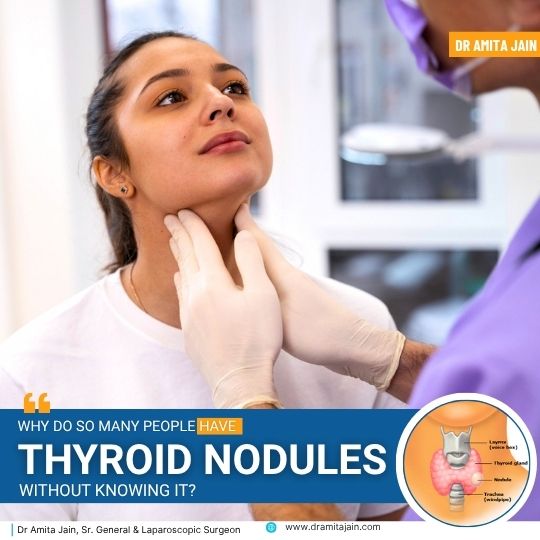
Why Do Thyroid Nodules Often Go Undetected?
The primary reason so many people have thyroid nodules without knowing it is that these growths usually do not cause symptoms, especially when they are small. The thyroid gland can continue producing hormones normally, and the nodule may not be large enough to be felt or seen.
Many nodules are discovered incidentally during ultrasounds, CT scans, or MRI scans investigating unrelated neck, spine, or chest problems.
This is why thyroid nodules are often called incidental findings, and Thyroid treatment in Delhi may be discussed.
Thyroid surgeon Dr Amita Jain says that “Most thyroid nodules are harmless, but knowing they’re there is the first step toward protecting your thyroid health.” – Dr Amita Jain, Senior General & Laparoscopic Surgeon and Specialist Thyroid Surgeon.
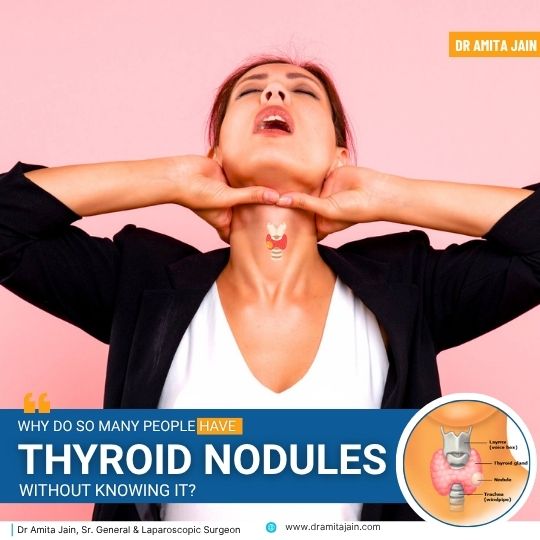
Age Increases the Likelihood
The likelihood of developing thyroid nodules increases with age, a consideration in Thyroid treatment in Delhi.
Although thyroid nodules can occur at any age, they are seen more frequently in adults over 40 and become increasingly common in later decades of life.
Women Are More Commonly Affected
Women develop thyroid nodules significantly more often than men. Hormonal changes throughout life, including pregnancy and menopause, may contribute to this increased prevalence.
Despite being more common in women, thyroid nodules can affect anyone and should always be evaluated if detected.
Most Nodules Do Not Affect Thyroid Function
Many people assume that every thyroid nodule causes thyroid disease, but this is not the case. Most nodules do not interfere with hormone production and therefore do not produce symptoms of hypothyroidism or hyperthyroidism. When hormone levels remain normal, individuals may continue their daily lives without realizing a nodule is present.
Some Nodules Become Noticeable Over Time
Although small nodules are often silent, larger nodules may eventually cause symptoms such as:
- A Visible Lump in the Neck – A swelling or lump at the base of the neck may become noticeable, particularly while swallowing or looking in a mirror.
- Difficulty Swallowing – Large nodules can press against the food pipe, making swallowing uncomfortable.
- Hoarseness or Voice Changes – If a nodule affects nearby nerves controlling the voice box, persistent hoarseness may occur.
- Pressure in the Neck – Some people experience a sensation of fullness, tightness, or pressure in the front of the neck.
How Are Thyroid Nodules Diagnosed?
When a thyroid nodule is suspected, your doctor may recommend several tests to determine its size, characteristics, and whether it requires further evaluation.
- Physical Examination – The thyroid gland is examined for enlargement or palpable lumps.
- Thyroid Ultrasound – Ultrasound is the most effective imaging test for evaluating thyroid nodules. It helps determine the size, number, and appearance of the nodules.
- Thyroid Function Blood Tests – Blood tests measure thyroid hormone levels and thyroid-stimulating hormone (TSH) to assess how well the gland is functioning.
- Fine Needle Aspiration (FNA) Biopsy – If a nodule has suspicious ultrasound features or is large enough, a fine needle aspiration biopsy may be recommended to determine whether it is benign or malignant.
Are Thyroid Nodules Cancerous?
The good news is that most thyroid nodules are not cancer. Only a small percentage are found to be malignant after proper evaluation. Doctors assess several factors, including ultrasound appearance, size, growth pattern, and biopsy results, before deciding on the appropriate treatment or follow-up plan.
When Should You See a Doctor?
Medical evaluation is recommended if you notice:
- A New Lump in the Neck – Any persistent swelling should be examined, even if it is painless.
- Difficulty Swallowing or Breathing – Compression symptoms should never be ignored.
- Persistent Hoarseness – Voice changes lasting more than two weeks deserve medical attention.
- Rapidly Enlarging Neck Swelling – A nodule that grows quickly requires prompt assessment.
Thyroid nodules are far more common than many people realize, and most remain unnoticed because they cause no symptoms and do not affect thyroid function. Fortunately, the majority are benign and can be safely monitored or treated when necessary. Regular health check-ups, awareness of neck changes, and timely medical evaluation help ensure that any thyroid nodule is properly diagnosed and managed, providing peace of mind and protecting long-term thyroid health.

Dr Amita Jain is one of India’s most distinguished and experienced female surgeons and proctologists, known for her unmatched expertise in general, advanced laparoscopic, and laser proctology surgery. With over 30 years of surgical excellence, Dr Amita Jain has built a reputation for precision, compassionate care, and advanced surgical techniques.
Dr Jain has successfully performed a wide range of complex general surgeries, including both open and minimally invasive procedures, with a strong focus on trauma care, onco-surgical techniques, and reconstructive surgeries. Her medical specialisation includes: gallbladder surgeries, appendix removal surgeries, hernia repair surgeries, Pilonidal Sinus treatments, varicose vein and piles surgeries, fistula surgeries and fissure surgeries.
Dr Jain, currently serves as Senior Consultant and Head of Department (General, Laser, Proctology and Laparoscopic Surgeries) across premier medical networks in South Delhi:
Daffodils by Artemis Hospitals: Spring Meadows, East of Kailash, New Delhi. Book Appointment
Fortis C-DOC Hospital: B-16, Chirag Enclave, New Delhi. Book Appointment
Rosewalk Luxury Multi-Specialty & Maternity Hospital: Panchsheel Park, New Delhi. Book Appointment
Rainbow Children’s Hospital: Malviya Nagar, New Delhi. Book Appointment
Learn More about Dr Amita Jain.
Dr Amita Jain has also authored some of the key medical journals and publications, like ResearchGate, IJSR
Note: This article is written and reviewed by Dr Amita Jain, while referring to her medical journals and publications.