
What is laser treatment for piles? Is it better than conventional surgery? Answers Dr Amita Jain, top surgeon for painless… Read more

- 19
- Nov
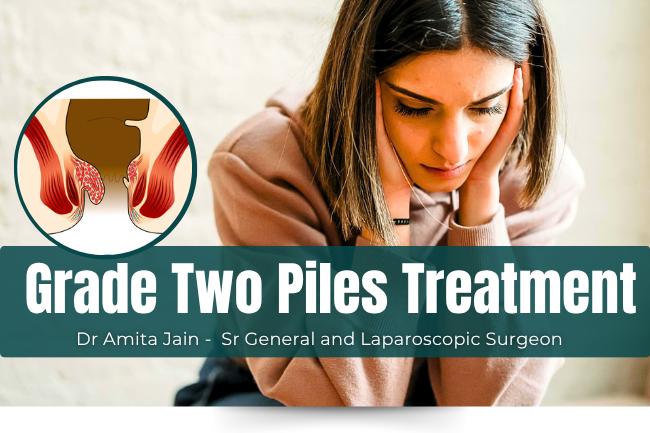
Drawing from over 29 years of surgical experience, including my tenure as an Indian Army Surgeon, I have found that Grade 2 piles represent a critical 'turning point' for patients. While early-stage piles can often be reversed with lifestyle correction alone, Grade 2 piles require a more structured and closely monitored approach
The most common mistake patients make at this stage is thinking it’s 'gone' because it goes back inside on its own. I always tell my patients: Grade 2 is the 'Golden Window.' It is the best time to treat the condition with 100% success using non-surgical methods before it becomes a permanent protrusion (Grade 3). In my clinical experience, patients often describe a sliding or heavy sensation during a bowel movement. While it is a relief that the mass returns inside on its own indicating that the supporting internal tissues are beginning to weaken and require immediate stabilization.
Dr Jain explains “Grade 2 piles mark the transition point where ignoring symptoms can lead to progression. Treatment here is about control with precision—timely support, not over-treatment. If handled correctly, we can still avoid major surgery in most patients.
Symptoms become more noticeable and frequent compared to Grade 2:
These symptoms often begin to interfere with daily routine, which is when most patients seek medical advice.
This stage develops when early warning signs are ignored or internal pressure continues over time. Common contributing patterns include:
Dr Jain focuses on interrupting this progression cycle while simultaneously stabilizing the condition.
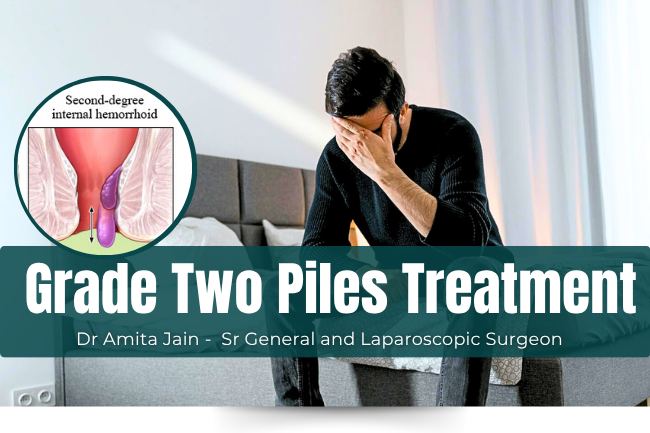
Unlike Grade 1, treatment here is multi-layered and more proactive.
1. Bowel Regulation & Habit CorrectionThe 5-Minute Rule: I advise all my patients to limit toilet time to under five minutes. Prolonged sitting—often worsened by using mobile phones—puts immense pressure on sensitive internal areas and is a primary reason Grade 2 piles progress to Grade 3 piles
These are used strategically and temporarily, not as a long-term dependency.
"For Grade 2 piles that don't resolve with lifestyle changes, I typically recommend Sclerotherapy or Infrared Coagulation. These are highly effective, needle-based or light-based treatments that shrink the internal mass without any cutting. In my experience, these 'walk-in, walk-out' procedures are the best way to stop bleeding immediately and prevent the need for future surgical intervention."
Here, Dr Amita Jain’s experience as a former Indian Army surgeon becomes particularly relevant. Her surgical approach is defined by:
She prefers minimally invasive techniques wherever possible, ensuring patient comfort and safety remain central.
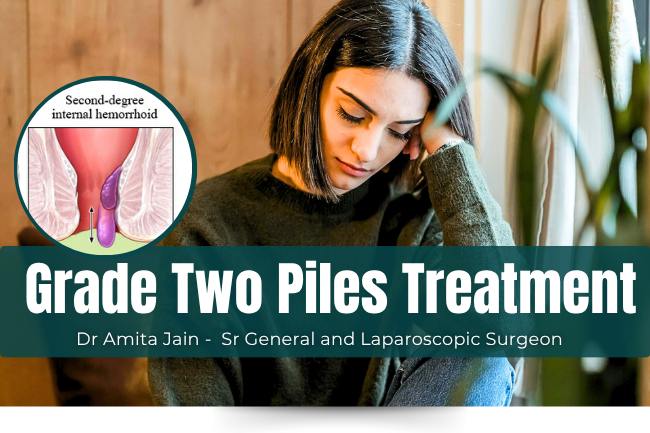
Immediate medical evaluation is important if:
Early intervention at Grade 2 can prevent the need for advanced surgical procedures later.
Managing Grade 2 piles successfully also depends on maintaining corrected habits:
The goal is not just symptom relief—but preventing progression to Grade 3 or Grade 4 piles.
Conservative-First Philosophy: I prioritize preserving the natural anatomy through medical management and advanced OPD procedures, reserving surgery only as a last resort.
Currently, the senior general and laparoscopic surgeon at Rosewalk Luxury Maternity Hospital, Panchsheel Park, Delhi, Dr Jain brings a level of expertise shaped by her time at AIIMS and her service as a trauma surgeon in the Indian Army.
Apart from Rosewalk Hospital, she is also a Senior General Surgeon at Fortis C-DOC, Chirag Enclave, Delhi and Rainbow Children’s Hospital, Malviya Nagar, South Delhi. She has a Post Doctoral Fellowship in Trauma & Critical Care from AIIMS, New Delhi.
Book and Appointment

Check out the latest updates on piles treatments by
Dr Amita Jain
What is laser treatment for piles? Is it better than conventional surgery? Answers Dr Amita Jain, top surgeon for painless… Read more

What can you do if piles keep coming back? Answers Dr Amita Jain, who is a leading general and laparoscopic surgeon and one of the best specialist doctors and surgeons for piles treatments in Delhi...... Read more

Recovering from piles surgery can feel like a daunting process, but with the right care, smart lifestyle choices, and a positive mindset, healing can be smoother than you think, shares Dr Amita Jain who is one of the most experienced piles surgeons in India..... Read more